What is a BMS The Ultimate Guide to Jump Starter Safety Protections
March 13th , 2026 | AstroAI *
From Spark-Proof Tech to Reverse Polarity: Decoding the 8 Core Smart Protections
In the past, jump-starting a car using traditional jumper cables connected to a donor vehicle was a nerve-wracking task. Old-school cables lack any logical judgment; they often accompany blinding sparks, the risk of battery explosion, and can instantly fry your car's expensive Engine Control Unit (ECU) if you accidentally cross the positive and negative terminals.
Today, portable lithium jump starters have revolutionized roadside assistance with their compact size and massive peak amps (capable of releasing thousands of amps in milliseconds). However, lithium batteries are inherently active and sensitive. The true unsung hero that makes this technology "foolproof" and absolutely safe for beginners is hidden within the smart clamps: the BMS (Battery Management System). This guide demystifies the incredible technology behind the AstroAI smart jumper clamps.
Abstract: How Does a BMS Work?
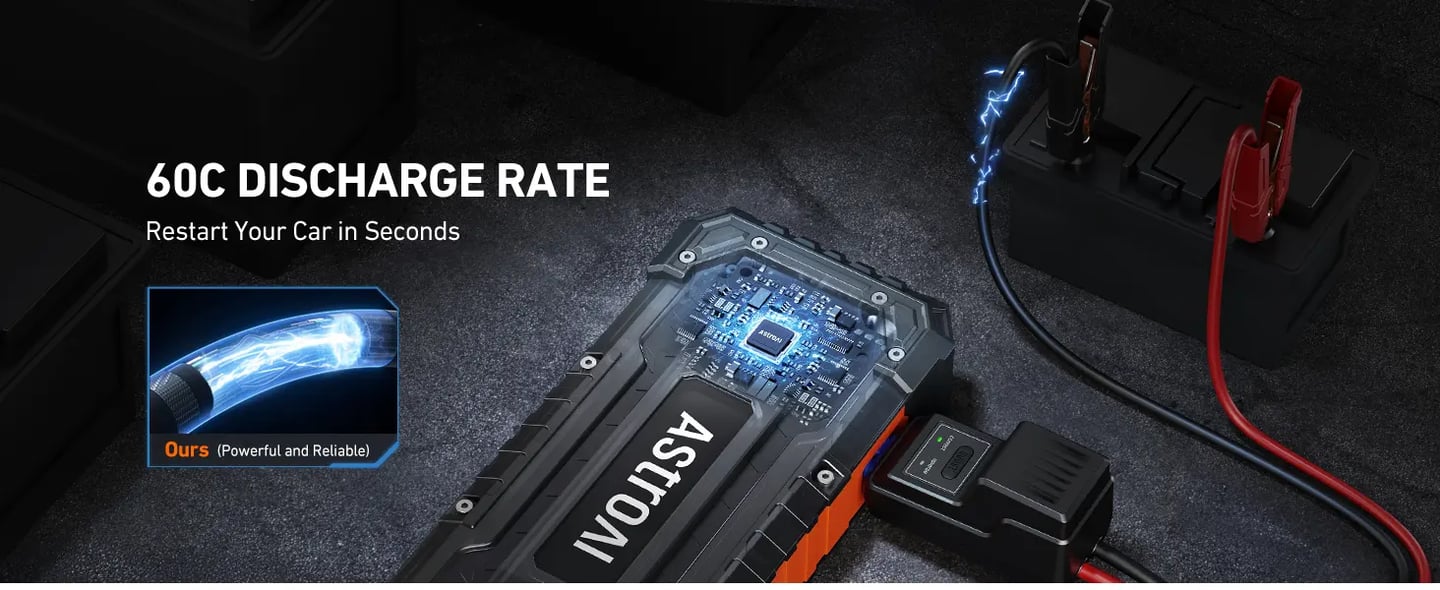
Lithium batteries boast incredibly high energy density. Without strict regulation, an uncontrolled release of this energy can lead to what battery engineers refer to as "thermal runaway"—a rapid, uncontrollable increase in temperature [1]. The BMS acts as the "brain" and "gatekeeper" of the jump starter. When you attach the clamps to a car battery, the internal Microcontroller Unit (MCU) performs thousands of calculations per second, continuously monitoring voltage, current, temperature, and polarity. Only when all safety thresholds are met will the built-in MOSFET relay close, allowing heavy current to flow.
- Spark-Proof Technology: Unlike traditional cables, smart clamps remain completely "dead" (unpowered) until correctly connected to a battery. They will never spark, even if you touch them together.
- Reverse Polarity is Standard: Hooked up the clamps backward in the dark? The BMS instantly locks the circuit and sounds an alarm, guaranteeing zero damage to your vehicle.
- Protects Your Car & The Device: Advanced over-charge and over-discharge protections drastically extend the lifespan of the internal lithium cells, preventing them from "dying" in storage or swelling.
The 8 Core BMS Protections Explained
Modern premium jump starters, like the AstroAI S8 Series, come standard with the following 8-layer smart protection system. Here is how they save your vehicle and device in extreme or accidental scenarios.
| Protection Type | Trigger Scenario & Risk | BMS Action & Result |
|---|---|---|
|
1. Reverse Polarity (Anti-Reverse) |
In low light or under stress, you accidentally connect the red clamp to the negative terminal and the black clamp to the positive. Traditional cables would cause catastrophic shorting and ECU burnout. | The smart chip detects reversed polarity potentials. The MOSFET relay remains open, physically blocking any current output. A red light illuminates and an audible beep alerts you until the connection is corrected. |
|
2. Short-Circuit (Anti-Spark) |
You accidentally touch the live red and black clamps together, or both clamps touch the metal car chassis simultaneously. | Triggers ultra-fast power cut-off. Current sensors detect an abnormal current spike in microseconds, instantly severing the output, completely eliminating dangerous sparks and occupational hazards linked to battery arcing [2]. |
|
3. Over-Current (Current Limit) |
The vehicle's starter motor has a severe fault (e.g., seized), drawing a massive current that exceeds the jump starter's physical limits. | If the discharge current exceeds the device's calibrated safety threshold, the BMS automatically halts power delivery, preventing internal wires from melting or lithium cells from being damaged. |
|
4. Over-Voltage (Voltage Lockout) |
Mistakenly connecting a jump starter designed for 12V cars to a 24V heavy-duty commercial truck or tractor battery. | Voltage sensors detect the incoming voltage exceeds 15V (the upper safe limit for 12V systems). The system forces a lockout, prohibiting current output to protect the device's internal electronics from high-voltage breakdown. |
|
5. Over-Temperature (Thermal Control) |
Continuous, repeated attempts to jump-start a stubborn engine cause the lithium cells and clamps to heat up rapidly. | A built-in high-precision NTC thermistor constantly monitors cell temperature. When it crosses the redline (usually 140°F / 60°C), the system enters a forced cooling sleep mode until temperatures normalize, thoroughly preventing fire hazards. |
|
6. Reverse-Charge (Alternator Block) |
After a successful start, the car's alternator immediately kicks in, generating a high-voltage current (14V+) to charge its own battery. | Special blocking diodes and chips act as a one-way valve. They automatically prevent the alternator's high-voltage current from back-feeding into the jump starter, ensuring the lithium cells are not damaged by rapid overcharging. |
|
7. Over-Charge (Input Protection) |
Charging the device overnight via a wall adapter and forgetting to unplug it after it reaches 100%. | Once the internal cells reach their maximum safe voltage capacity, the BMS automatically cuts off the charging current from the Type-C port, preventing battery swelling, overheating, or potential explosion. |
|
8. Over-Discharge (Deep Sleep) |
Leaving the jump starter in your trunk for over a year without use, causing natural parasitic battery drain. | Lithium batteries suffer irreversible crystallization and capacity fade if drained completely to 0V [5]. When cell voltage drops to a critical low, the BMS proactively locks the device into a "deep sleep" state to preserve the absolute minimum baseline charge, preventing the battery from "dying" permanently. |
⚠️ Deep Dive: The Risks and Rewards of the "BOOST" Button
Despite the supreme intelligence of the BMS, there is one specific scenario where it will intentionally "go on strike": when your car's battery is completely dead or its voltage has been drained to the absolute bottom.
Under normal conditions, the anti-short and spark-proof technologies rely on one prerequisite: the BMS must detect a faint voltage from the car battery (usually between 2V and 9V). This confirms the polarity is correct and the clamps are attached to a real battery, prompting the relay to open and output current. However, if your battery voltage is close to 0V, the smart clamp cannot sense it (it assumes the clamps are just hanging in the air). Thus, no green light, no power. In this rare case, you must press the "Boost" (or manual override) button to tell the BMS: "I've verified the connections, force the power output."
Safe Operating Guidelines:
1. Before pressing Boost, you MUST visually double-check: Red clamp on Positive (+), Black clamp on Negative (-).
2. Once pressed, the internal relay is forcibly closed. The clamps become "live" (reverting to the behavior of traditional jumper cables).
3. If reverse polarity or a short circuit occurs now, it is extremely dangerous and will result in massive sparks or equipment damage. Remove the clamps immediately once the vehicle starts.
🌙 Real-World Case Study: Salvation in the Midnight Rain
Technical specs can be dry, but in crucial moments, they save the day. Here is a real-world scenario from an AstroAI user:
- The Scenario: At 10:00 PM in pouring rain, an SUV was stranded on a dark, deserted road. The battery was completely depleted after headlights were left on.
- The Incident: Due to terrible visibility and panic, the driver hastily connected the AstroAI smart red clamp to the battery's negative terminal, and the black clamp to the positive.
- Consequences without a BMS: If traditional cables were used, the instant short circuit caused by reversed polarity would have generated high-heat electric arcs, potentially causing the battery to explode, or instantly frying the vehicle's sensitive Body Control Module (resulting in thousands of dollars in repairs).
- The Actual Result: The AstroAI smart clamps instantly flashed a bright red warning light accompanied by a continuous, high-frequency "beep-beep" alarm. The relay locked down hard—zero current output, zero sparks, zero damage. The driver adjusted the clamps according to the alarm, the green light illuminated, and the vehicle started successfully on the first try.
🏆 Recognized for Excellence, Safety, and Reliability
The advanced BMS featured in the AstroAI S8 Series Jump Starters isn't just theoretically safe—it is rigorously tested and globally certified to adhere to the highest consumer electronic and automotive safety standards.
- Amazon Bestseller & Top Rated: With over tens of thousands of units sold globally, the AstroAI S8 series proudly maintains a stellar 4.8/5-star rating. Verified buyers frequently highlight its "idiot-proof safety features" and "lifesaving reliability in dead of winter."
- Automotive Expert Recommended: Highly praised by top automotive DIY channels and professional mechanics. Experts consistently point out that AstroAI's instantaneous reverse-polarity detection and robust NTC thermistors set it apart from cheaper, generic alternatives on the market.
- Industry Standard Compliance: The internal architecture is built to withstand extreme electrical surges, satisfying the strict requirements laid out by UL 2743 [3] for portable power packs, and ensuring zero electromagnetic interference to vehicle computers per FCC and CE directives [4].
🔧 Frequently Asked Questions (FAQ)
Q: If I accidentally touch the red and black clamps together, will it explode?
A: No. Thanks to anti-short and spark-proof technology, the internal circuit remains completely open (disconnected) under normal mode until the BMS detects the correct polarity of a car battery. Even if the clamps touch, no current flows. The device will not react, making it 100% safe.
Q: After the car starts, will the alternator's high voltage charge and ruin my jump starter if I don't remove it immediately?
A: Don't panic. Our BMS features Reverse-Charge Protection. Once the engine starts, the alternator runs at approximately 14.4V. The hardware inside the smart clamps acts like a one-way valve, preventing reverse current from feeding back into the unit and damaging the cells. Nevertheless, for optimal safety, we strongly recommend removing the clamps within 30 seconds of starting the vehicle.
Q: Why are my smart clamps flashing green and red alternately, refusing to jump my car?
A: This is typically the Over-Temperature Protection or Low-Battery Protection kicking in. If you've just made several consecutive failed start attempts, the high-current discharge drastically raises the cell temperature, forcing the BMS to cut power for cooling. Unplug the clamps and wait 5-10 minutes before trying again. Also, ensure your jump starter has at least 50% battery life to deliver optimal peak amps.
Q: Why don't standard, cheap jumper cables have these features?
A: Standard jumper cables are merely thick copper wires with no chips, relays, or logical reasoning. They rely 100% on the accuracy of human operation. A modern smart jump starter is essentially a small computer with a massive battery attached to it, completing a full safety diagnostic before allowing any current to flow.
Q: Can I just leave the jump starter in my trunk year-round for emergencies without maintaining it?
A: While the BMS has "Over-Discharge Protection" to prevent the battery from dying completely, lithium batteries naturally self-discharge over time. If left uncharged for a year, its performance drops significantly, and it may not deliver enough peak amps during an emergency. To guarantee foolproof readiness, we recommend checking the battery level every 3 to 4 months and recharging it to above 80%.
Conclusion: True Performance is Rooted in Safety
When shopping for a jump starter, many focus solely on the "Peak Amps" because it determines whether the device can start your car. However, the quality of the BMS determines whether you can confidently and safely use it. A rigorously calibrated BMS acts as an invisible shield, eliminating almost all room for human error. It empowers any driver, regardless of mechanical experience—even in the dead of night during a storm—to safely perform a self-rescue. Say goodbye to the hazards of traditional jumper cables and embrace the peace of mind that smart technology brings to your travels.
References
- IEEE Standards Association - IEEE Standard for Rechargeable Batteries for Multi-Cell Mobile Computing Devices. (Details guidelines on preventing thermal runaway in lithium cells). ^
- Occupational Safety and Health Administration (OSHA). Preventing Fire and/or Explosion Injury from Small and Wearable Lithium Battery Powered Devices. SHIB 01-18-2019. ^
- Underwriters Laboratories (UL). UL 2743 Standard for Portable Power Packs. (The benchmark safety standard evaluating performance, short-circuit protection, and environmental resistance for vehicle jump starters). ^
- Federal Communications Commission (FCC). Equipment Authorization – RF Device. (Ensures electronic BMS components do not emit harmful electromagnetic interference affecting vehicle ECUs). ^
- Battery University (Cadex Electronics). BU-808: How to Prolong Lithium-based Batteries. (Explains the impact of deep discharge to 0V and capacity fade over time). ^