Jump Starter Selection • Engine Match Guide • 2026
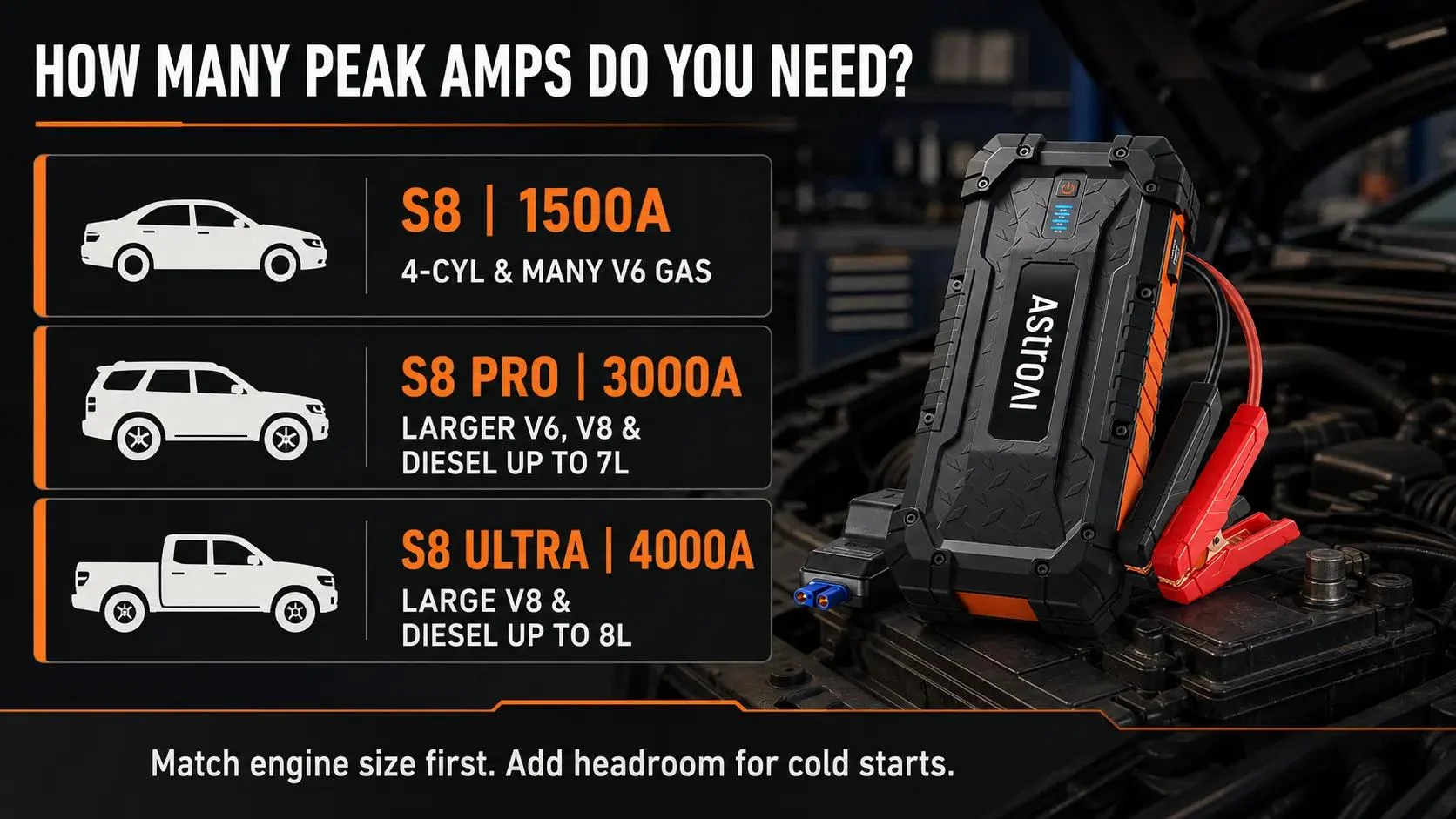
Peak Amps Explained: How Many Peak Amps Do You Need for a Jump Starter?
Quick answer: For many common gasoline passenger vehicles, a 1500A jump starter is a practical starting class when the engine falls within the manufacturer's published displacement rating. A larger V6, V8, cold-weather vehicle, or diesel often benefits from a 3000A or 4000A class. But cylinder count alone is not enough: fuel type, engine displacement, battery condition, temperature, cable resistance, clamp contact, and the jump starter's state of charge all affect whether the engine cranks.
The best choice is not automatically the largest advertised number. First match the manufacturer's gasoline or diesel engine rating, then add reasonable headroom for cold starts and difficult conditions. Within the AstroAI lineup used here, that creates a clear progression from S8 at 1500A to S8 Pro at 3000A and S8 Ultra at 4000A.
Peak-Amp Starting Points
- Four-cylinder gasoline vehicle: a 1500A class is a sensible starting point when the engine is inside the published rating and conditions are moderate.
- V6 gasoline vehicle: 1500A can cover many engines, but 3000A provides more margin for larger displacement, cold weather, or a deeply discharged but undamaged battery.
- V8 gasoline vehicle: consider the 3000A to 4000A class and verify the exact engine-liter rating.
- Diesel: use displacement rather than cylinder count. The published AstroAI ranges in this guide progress from up to 3L diesel at 1500A, to 7L at 3000A, and 8L at 4000A.
- Hard-start conditions: move up one practical tier when frequent freezing temperatures, an older battery, or higher-resistance connections are likely, but never use extra peak amps as a substitute for battery diagnosis or correct clamps.
Engine and Condition Guide
Peak-Amp Selection Table: 4-Cylinder, V6, V8, and Diesel
The ranges below are practical selection bands within the current AstroAI lineup, not universal minimums for every manufacturer. Engine displacement and the model's published engine rating are more reliable than cylinder count alone.
| Vehicle / Engine |
Practical Class |
AstroAI Match |
When to Add Headroom |
Do Not Assume |
| Four-cylinder gasoline | About 1500A class | S8: published for gasoline engines up to 6L | Regular freezing starts, older battery, repeated emergency use, or larger-than-typical displacement | That every four-cylinder needs the same current |
| V6 gasoline | 1500A to 3000A class | S8 within its 6L rating; S8 Pro for more margin and engines up to 9L gasoline | Cold climate, large SUV or van, high-compression engine, or reduced jump-pack charge | That V6 automatically means 3000A is mandatory |
| V8 gasoline | 3000A to 4000A class | S8 Pro: up to 9L gasoline; S8 Ultra: up to 10L gasoline | Large pickup or SUV, freezing starts, infrequent maintenance, or consistently difficult cranking | That peak amps repair a worn starter or failed battery |
| Diesel up to 3L | About 1500A class | S8: published for diesel engines up to 3L | Frequent below-freezing starts or a vehicle near the upper displacement limit | That diesel and gasoline of equal size crank identically |
| Diesel 3L to 7L | About 3000A class | S8 Pro: published for diesel engines up to 7L | Heavy vehicle, cold soak, dual-battery architecture, or engine near 7L | That one clamp location fits every diesel vehicle |
| Diesel 7L to 8L | About 4000A class | S8 Ultra: published for diesel engines up to 8L | Severe cold, heavy-duty service, dual batteries, or repeated starts away from assistance | That a 12V unit is suitable for a 24V electrical system |
What Peak Amps Actually Mean
Peak amps describe a brief maximum output capability, not a current the jump starter continuously forces into the vehicle. The starter motor and electrical path draw the current demanded by the cranking event, up to the limits of the battery, jump starter, cables, clamps, and connections. Connecting a higher-rated compatible 12V jump starter does not make a healthy starter motor consume its full advertised peak rating.
Peak amps are also not the same as battery CCA. Cold Cranking Amps is a standardized rating for a vehicle battery under specified cold conditions. A portable jump starter's peak output is a short-duration device rating. Because test definitions may differ among brands and products, use the manufacturer's engine-displacement rating, voltage compatibility, and operating instructions rather than comparing only the largest number on the package.
Peak output
A short-duration ceiling used to support engine cranking.
Starting current
The current actually delivered during the starting event, affected by the entire circuit.
Battery CCA
A vehicle-battery cold-cranking rating; useful context, but not interchangeable with jump-starter peak amps.
Why More Peak Amps Are Not Automatically Better
Additional output margin can be useful, especially for diesel engines and cold weather. But once a jump starter comfortably covers the vehicle and conditions, a still-larger number may add size, weight, charging time, or cost without changing a normal start. Reliability depends on more than the label.
- Engine rating beats cylinder shorthand: a compact V6 and a large V6 do not have identical cranking needs.
- Charge level matters: a partially charged high-amp pack can perform worse than an appropriately sized pack kept ready.
- Clamp contact matters: corrosion, small contact area, loose jaws, or damaged cables create resistance and voltage drop.
- Battery health matters: a jump starter can assist a discharged battery but cannot repair an internally failed, frozen, leaking, swollen, or shorted battery.
- Protection design matters: smart clamps and clear status indicators help prevent mistakes that raw output alone cannot solve.
AstroAI Peak-Amp Tiers
Three Clear Starting Points
These are use-case tiers, not a ranking based on price. The published engine rating is the boundary; difficult conditions may justify moving up, while a damaged battery or mechanical fault requires diagnosis instead of more peak amps.
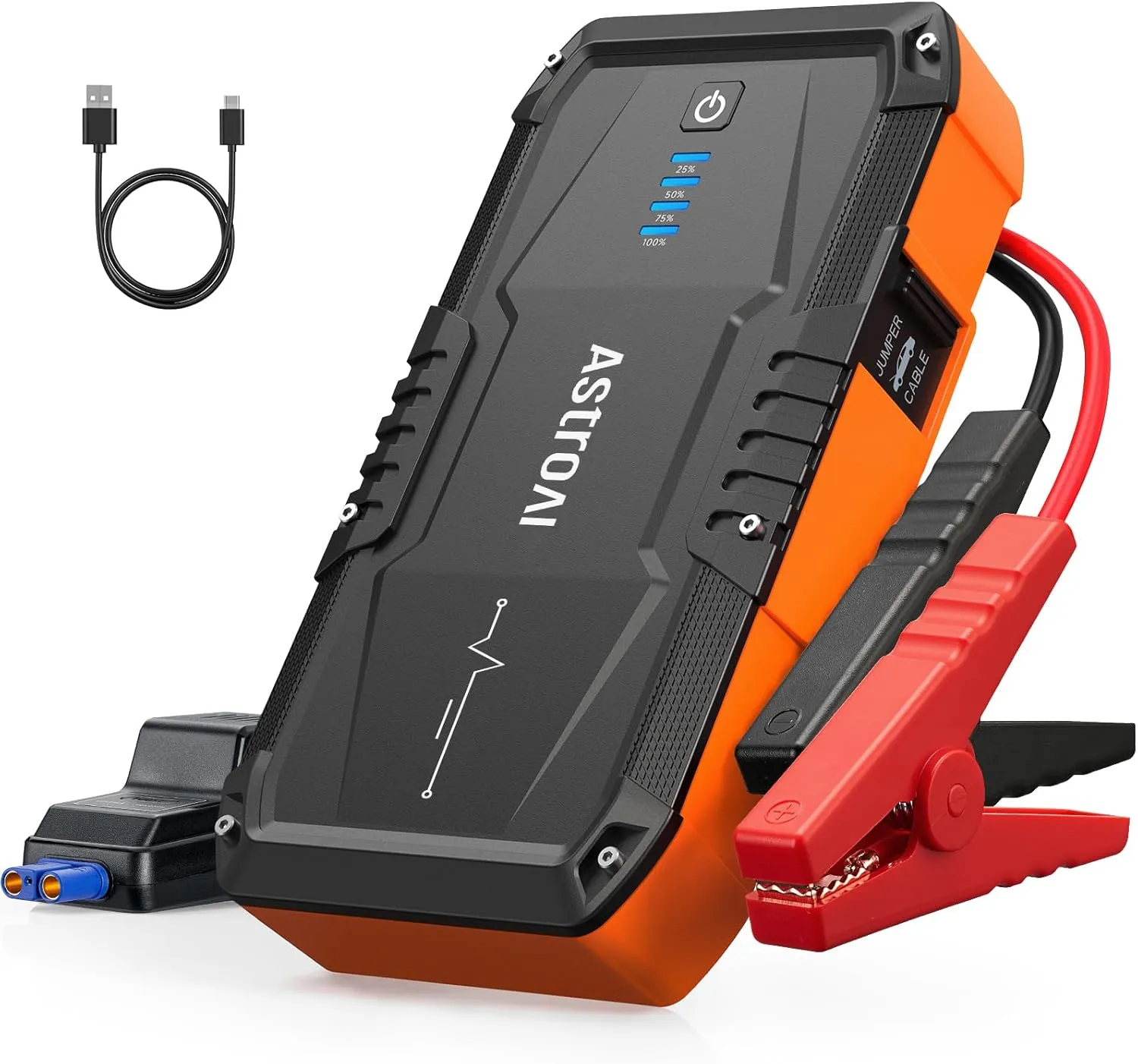
Common passenger-vehicle tier
AstroAI S8 — 1500A Peak
Best for: many four-cylinder and V6 gasoline vehicles, motorcycles, and smaller diesels when displacement is within the published rating.
Verified summary: 12V jump starter rated up to 6L gasoline and 3L diesel engines, with a published 1500A peak output and boost function.
Pros: Compact starting tier with enough published engine coverage for a wide range of passenger vehicles.
Cons: Less reserve for large diesels, large V8s, severe cold, or repeated difficult attempts.
Not best for: Engines above 6L gasoline or 3L diesel, 24V systems, or users who routinely face heavy-duty cold starts.
View S8
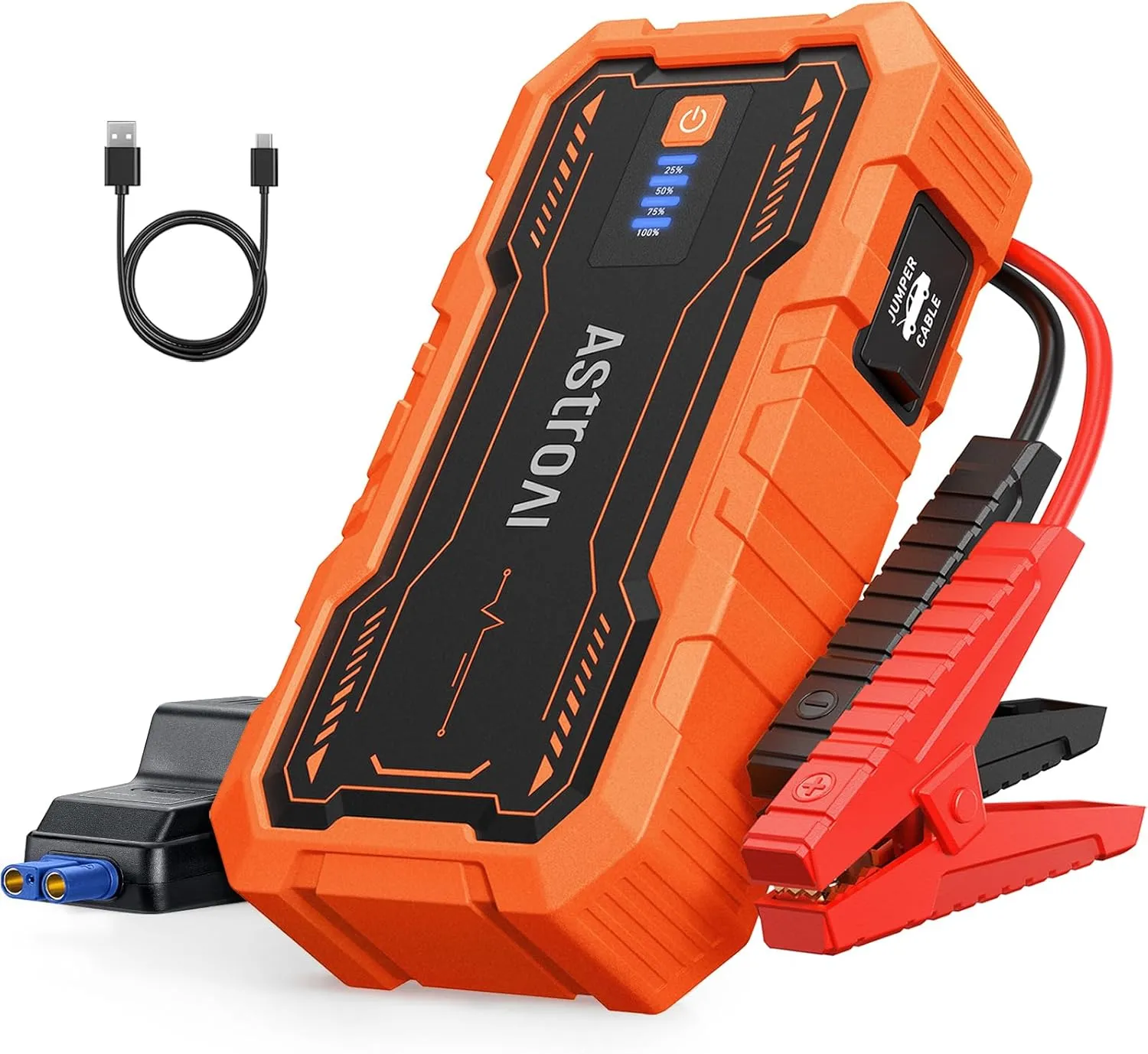
Balanced V6, V8, and diesel tier
AstroAI S8 Pro — 3000A Peak
Best for: larger V6 and V8 gasoline vehicles, SUVs, vans, light trucks, and medium-size diesel engines.
Verified summary: 12V jump starter with a published 3000A peak rating, up to 9L gasoline and 7L diesel engine coverage, and boost function.
Pros: Broad engine coverage and more cold-weather or aging-battery margin than the 1500A tier.
Cons: More capacity than many small gasoline cars need for moderate-condition emergency use.
Not best for: Diesel engines above 7L, gasoline engines above 9L, 24V systems, or a battery showing physical damage.
View S8 Pro
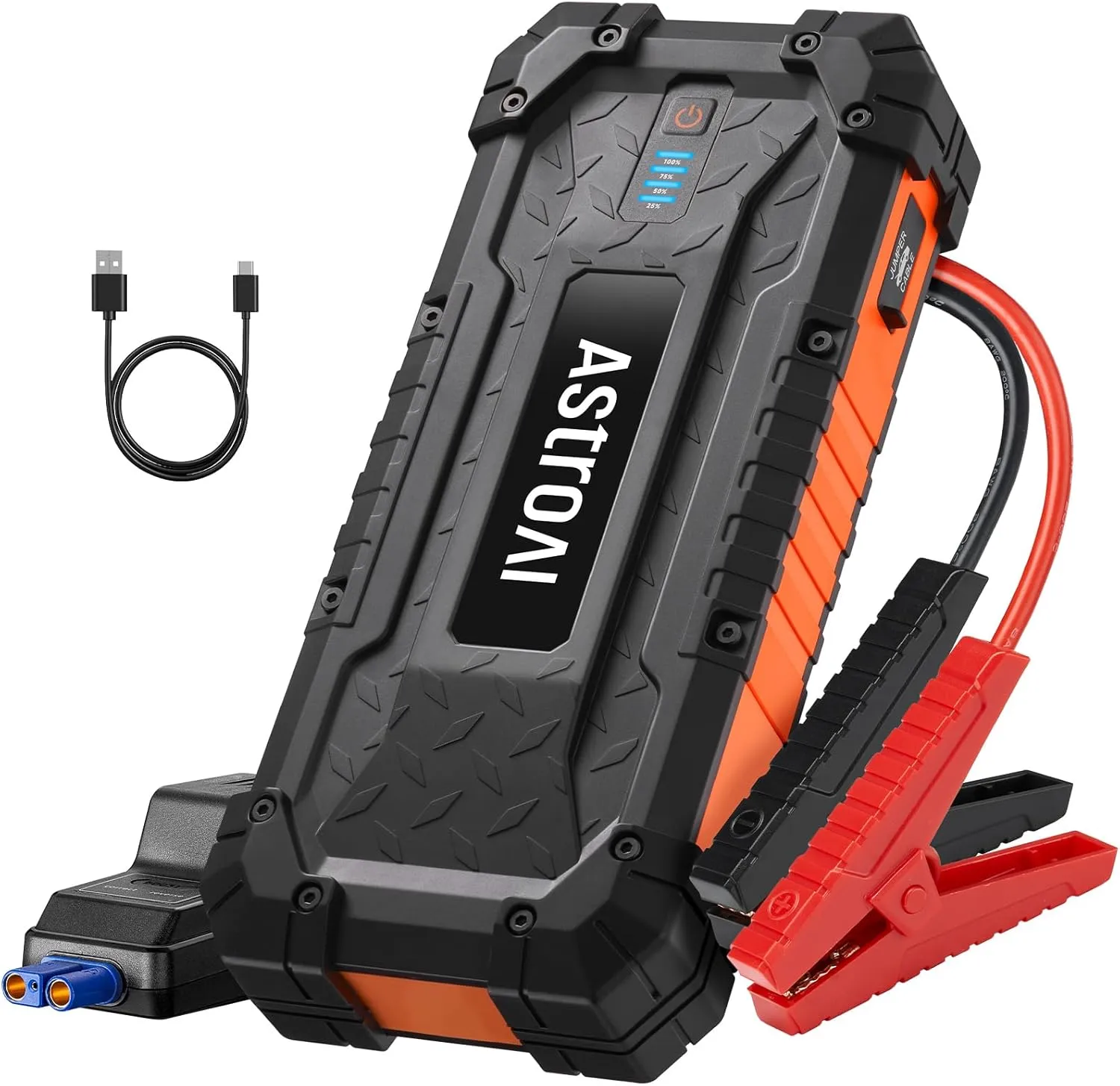
Large-engine and cold-weather tier
AstroAI S8 Ultra — 4000A Peak
Best for: large V8 gasoline engines, larger diesel pickups, colder environments, and users wanting more margin within the published rating.
Verified summary: 12V jump starter with a published 4000A peak rating, up to 10L gasoline and 8L diesel engine coverage, and boost function.
Pros: The widest gasoline and diesel engine coverage of the three models compared here.
Cons: More size and output margin than a small four-cylinder commuter usually needs.
Not best for: 24V vehicles, engines outside the published 10L gasoline or 8L diesel limits, or batteries that are frozen, leaking, swollen, or internally failed.
View S8 Ultra
S8 vs S8 Pro vs S8 Ultra
The comparison intentionally omits changing prices, review counts, and conflicting capacity fields. It keeps only the current published data that is consistent across the lineup and model pages.
| Model |
Peak Current |
Published Gas Rating |
Published Diesel Rating |
Best Scenario |
| S8 | 1500A | Up to 6L | Up to 3L | Compact passenger vehicle and smaller diesel emergency kit |
| S8 Pro | 3000A | Up to 9L | Up to 7L | V6, V8, SUV, van, light-truck, and medium-diesel coverage |
| S8 Ultra | 4000A | Up to 10L | Up to 8L | Large V8, larger diesel, colder climate, and higher-margin emergency use |
Battery State and Temperature Can Change the Answer
Weak but intact battery
This is the normal use case: the battery lacks enough energy to crank but has no visible damage. Match the vehicle and keep the jump starter well charged.
Deeply discharged battery
Smart clamps may not detect an extremely low battery. A supported boost or override function can energize the clamps, but it also reduces automatic protection. Use it only after confirming correct polarity, 12V compatibility, and an undamaged battery, exactly as the model manual directs.
Frozen, leaking, swollen, cracked, or shorted battery
Do not attempt a jump start. Physical damage or internal failure changes the task from low-charge recovery to a service and replacement problem.
Cold weather
Cold reduces the available output of both the vehicle battery and lithium jump starter while making the engine harder to turn. Keep the jump starter charged, follow its storage-temperature limits, and consider one tier of output margin for regular freezing starts.
Repeated no-start
More attempts are not always the answer. If the vehicle still does not start after the manual's permitted attempt and cool-down sequence, investigate the battery, starter, cables, fuel, ignition, immobilizer, or another fault.
Why Clamps and Connections Matter as Much as the Amp Rating
The starter current must travel through the jump starter's internal cells, protection circuit, cables, clamp pivots, clamp jaws, battery terminals, vehicle cables, and ground path. Resistance at any point creates voltage drop and heat. A high peak rating cannot compensate for a clamp touching only a small corroded edge.
- Inspect cable insulation, clamp springs, jaw conductors, and connector pins before use.
- Remove heavy corrosion and make firm metal-to-metal contact at the approved positive terminal and negative or chassis-ground point specified by the vehicle manual.
- Keep clamps separated and cables clear of belts, fans, pulleys, and hot exhaust components.
- Stop if a cable or clamp becomes unusually hot, the protection indicator shows a fault, or the connection cannot remain secure.
Safety Protection Is Part of the Selection
AstroAI's S8-series guidance lists built-in protection for conditions including reverse polarity, reverse connection, overcurrent, overvoltage, overload, overcharge, over-discharge, and short circuit. These protections help the smart clamps block unsafe output and report faults during normal automatic operation.
Protection is not permission to connect carelessly. Always verify red to positive and black to the approved negative or ground point. A boost or manual-override mode may intentionally bypass low-voltage detection and reduce automatic safeguards, so use it only when the manual allows and polarity has been visually confirmed.
Seven-Step Decision
How to Choose the Right Peak-Amp Class
- 1
Confirm system voltage. Verify the vehicle uses a compatible 12V starting system and follow its owner's manual for designated jump points.
- 2
Record fuel type and displacement. Use gasoline or diesel liters, not cylinder count alone, and note any dual-battery or special starting architecture.
- 3
Match the published engine rating. Choose a model whose stated gasoline or diesel limit equals or exceeds the actual engine displacement.
- 4
Assess the battery condition. Add margin for a deeply discharged but undamaged battery; do not attempt to jump a frozen, leaking, swollen, cracked, or internally failed battery.
- 5
Account for temperature. Consider one practical tier of headroom for regular freezing starts, while staying within storage and operating-temperature instructions.
- 6
Inspect clamps and protections. Look for sound cables, firm jaw contact, clear status indicators, reverse-polarity and short-circuit protection, and a documented boost procedure.
- 7
Plan storage and maintenance. Keep the unit charged according to its manual, inspect it periodically, and recharge it after use so the rated capability is available during an emergency.
How to Compare Jump Starters Fairly
Do not intentionally drain a healthy vehicle battery just to create a dramatic test. A useful comparison controls the vehicle, battery, temperature, pack charge, connection points, and attempt procedure.
| Control |
Record |
Why It Matters |
| Vehicle | Fuel, displacement, starter system, battery architecture | Different engines cannot be compared from peak amps alone |
| Battery | Battery type, age, resting voltage, visible condition, terminal cleanliness | A damaged or failing battery can invalidate the comparison |
| Environment | Ambient temperature and cold-soak duration | Cold changes battery output, jump-pack output, and engine drag |
| Jump starter | State of charge, storage temperature, clamp condition, fault indicators | A low or cold pack cannot represent its ready-state capability |
| Procedure | Connection point, attempt duration, wait interval, attempt count, successful start | Different procedures create different heating and voltage-drop results |
How We Selected the Models and Specifications
The product ladder uses current official lineup data and model pages checked on August 6, 2026. We selected three models with consistent peak-current and engine-rating information across the comparison and model pages. Prices, ratings, review counts, and conflicting capacity values were excluded.
The Bottom Line
Start with engine displacement and fuel type. For common four-cylinder and many V6 gasoline vehicles, S8's 1500A tier may be sufficient within its 6L gasoline rating. For larger V6/V8 vehicles, SUVs, vans, and medium diesels, S8 Pro's 3000A tier extends coverage to 9L gasoline and 7L diesel. For large V8s, larger diesels, and regular cold-weather use, S8 Ultra's 4000A tier provides coverage up to 10L gasoline and 8L diesel. Choose enough verified headroom, then protect that capability with a charged pack, clean terminals, firm clamps, and correct procedures.
Frequently Asked Questions
How many peak amps do I need for a four-cylinder car?
A 1500A class is a practical starting point for many four-cylinder gasoline cars when the engine is within the manufacturer's displacement rating and the battery is discharged but undamaged. Add margin for regular freezing conditions or difficult starts.
How many peak amps do I really need for a V6?
Many V6 engines fit within a 1500A unit's published gasoline rating, but a 3000A class provides more reserve for larger V6 engines, SUVs, vans, cold weather, and older batteries. Check engine liters rather than relying on cylinder count alone.
How many peak amps do I need for a V8?
A 3000A to 4000A class is a practical range for many V8 gasoline vehicles. S8 Pro is published for gasoline engines up to 9L, while S8 Ultra extends the published rating to 10L and provides more margin for cold or difficult starts.
How many peak amps do I need for a diesel?
Use diesel displacement: S8 is published up to 3L diesel at 1500A, S8 Pro up to 7L at 3000A, and S8 Ultra up to 8L at 4000A. Cold weather, dual-battery systems, and heavy-duty use may justify more margin within a compatible product range.
Can too many peak amps damage my car?
A compatible 12V jump starter does not continuously force its full peak rating into the starter motor. The circuit draws the current required for cranking. Damage risk comes from wrong voltage, reversed polarity, poor connections, bypassed protection, damaged batteries, or ignoring the vehicle and product instructions.
Are peak amps the same as battery CCA?
No. CCA is a standardized cold-cranking rating for a vehicle battery. Jump-starter peak amps describe a brief output capability and may be tested differently across products. Use the published engine rating and voltage compatibility for selection.
Will a jump starter work on a completely dead battery?
A deeply discharged battery may be below the smart clamps' detection threshold. Supported boost modes can help, but only after polarity and battery condition are verified and the manual permits it. Do not jump a frozen, leaking, swollen, cracked, or internally failed battery.
Should I buy more peak amps for cold weather?
Regular freezing starts justify additional headroom because cold reduces battery and jump-pack output while increasing engine drag. Moving one practical tier above the basic engine match can be reasonable, but the pack still must be charged, stored correctly, and connected with clean, firm clamps.