Daily Commuters
A compact combo can address two common interruptions without waiting for another vehicle or searching for a service-station compressor. It is especially useful for drivers who commute early, late, or alone.
August 12th , 2026 | AstroAI *
Vehicle Emergency Kit Guide
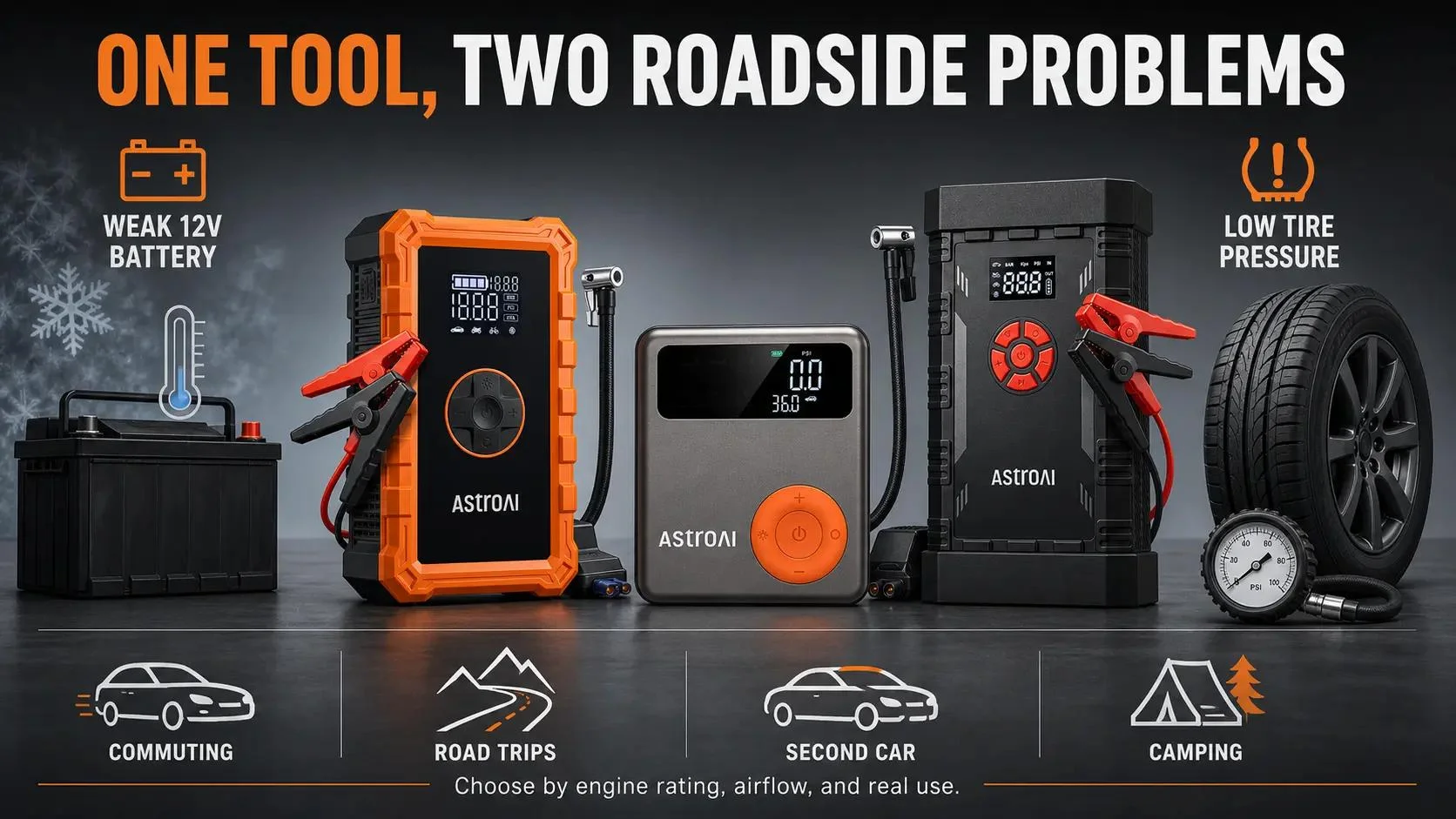
You probably need a jump starter with an air compressor if your vehicle emergency plan must cover both a weak 12V battery and gradual tire-pressure loss, especially when you commute alone, take long road trips, maintain a second family vehicle, or camp away from immediate help. A combo tool saves cargo space and keeps both functions in one charged unit.
Choose a two-in-one tool when low battery and low tire pressure are both realistic roadside problems and you value one compact kit over the smallest or most specialized individual tool.
Choose separate tools when you need stronger sustained compressor duty, want independent backup if one device is unavailable, or already own a suitable jump starter or inflator.
Do not choose by peak amps or maximum PSI alone. Match the published engine rating first, then compare airflow, hose access, auto shut-off, storage size, and the maintenance routine you will realistically follow.
You may not need both functions in one device if you already own reliable separate tools, need a high-duty compressor for repeated large-tire inflation, want the smallest possible jump pack, or use a vehicle outside the product's published 12V and engine-size limits. The useful question is not simply whether two functions sound convenient. It is whether one maintained combo tool fits your actual vehicle, tire, storage, and travel pattern.
A jump starter and a tire inflator solve different problems. The jump starter supplies short-duration current to help crank a vehicle with an undercharged 12V starting battery. The inflator adds air when a tire is below the vehicle manufacturer's recommended cold pressure. Neither function replaces the other.
Important boundary: an inflator cannot make a punctured, cut, bulging, unseated, or otherwise damaged tire safe. A jump starter cannot repair a worn-out battery, charging-system fault, starter fault, or fuel and ignition problem. Use each function as a temporary recovery tool and diagnose recurring issues.
Use-Case Check
A compact combo can address two common interruptions without waiting for another vehicle or searching for a service-station compressor. It is especially useful for drivers who commute early, late, or alone.
Long distances add exposure to temperature shifts, extended accessory use, unfamiliar parking areas, and fewer convenient service stops. One maintained unit simplifies packing.
A lightly used vehicle may sit long enough for battery charge and tire pressure to decline. A combo tool can support periodic driveway checks as well as unexpected starts.
Remote parking and longer stays make self-recovery more valuable. Some models also support bikes and sports balls, but every inflation task must remain within the product's listed use and duty limits.
A combo tool is primarily a packaging and readiness decision. It does not automatically outperform two purpose-built tools. Compare the tradeoffs that affect how the kit will actually be stored and used.
| Decision Factor | Combo Tool | Separate Tools | Choose Based On |
|---|---|---|---|
| Storage | One case and one main rechargeable unit | More pieces, but each can be sized independently | Available trunk space and whether the kit moves between vehicles |
| Readiness | One charging routine supports both emergency functions | Independent devices may preserve one function if the other is unavailable | Your willingness to inspect charge, cables, hose, and accessories |
| Inflation Duty | Well suited to top-offs and supported emergency inflation tasks | A dedicated compressor can prioritize airflow, hose reach, and longer duty cycles | Tire volume, starting pressure, frequency, and cool-down requirements |
| Jump Capability | Must be matched to engine and fuel type, not assumed from combo status | A jump-only model may offer a smaller body or a wider performance range | Published engine rating, 12V compatibility, temperature, and battery condition |
| Replacement | A problem with the shared unit can affect both functions | One tool can be upgraded or replaced without changing the other | How much you value modularity versus simplicity |
All four AstroAI models discussed below list a 150 PSI maximum, but that number is a pressure ceiling, not proof that they fill every tire equally quickly. Airflow, tire volume, starting pressure, available battery charge, hose seal, ambient temperature, and required cool-down intervals all affect the real task. For routine vehicle selection, compare supported tire types and published airflow before treating maximum PSI as a performance ranking.
Pros: one compact case, one primary charging routine, and coverage for two different roadside problems.
Cons: more size than a jump-only pack, less specialization than a dedicated compressor, and both functions depend on the same maintained battery pack.
AstroAI Two-in-One Options
These models all combine 12V jump-starting support with a 150 PSI inflator, but they target different levels of engine coverage, portability, and inflation performance. Product configurations can change, so confirm the exact selected product page and manual before purchase and use.
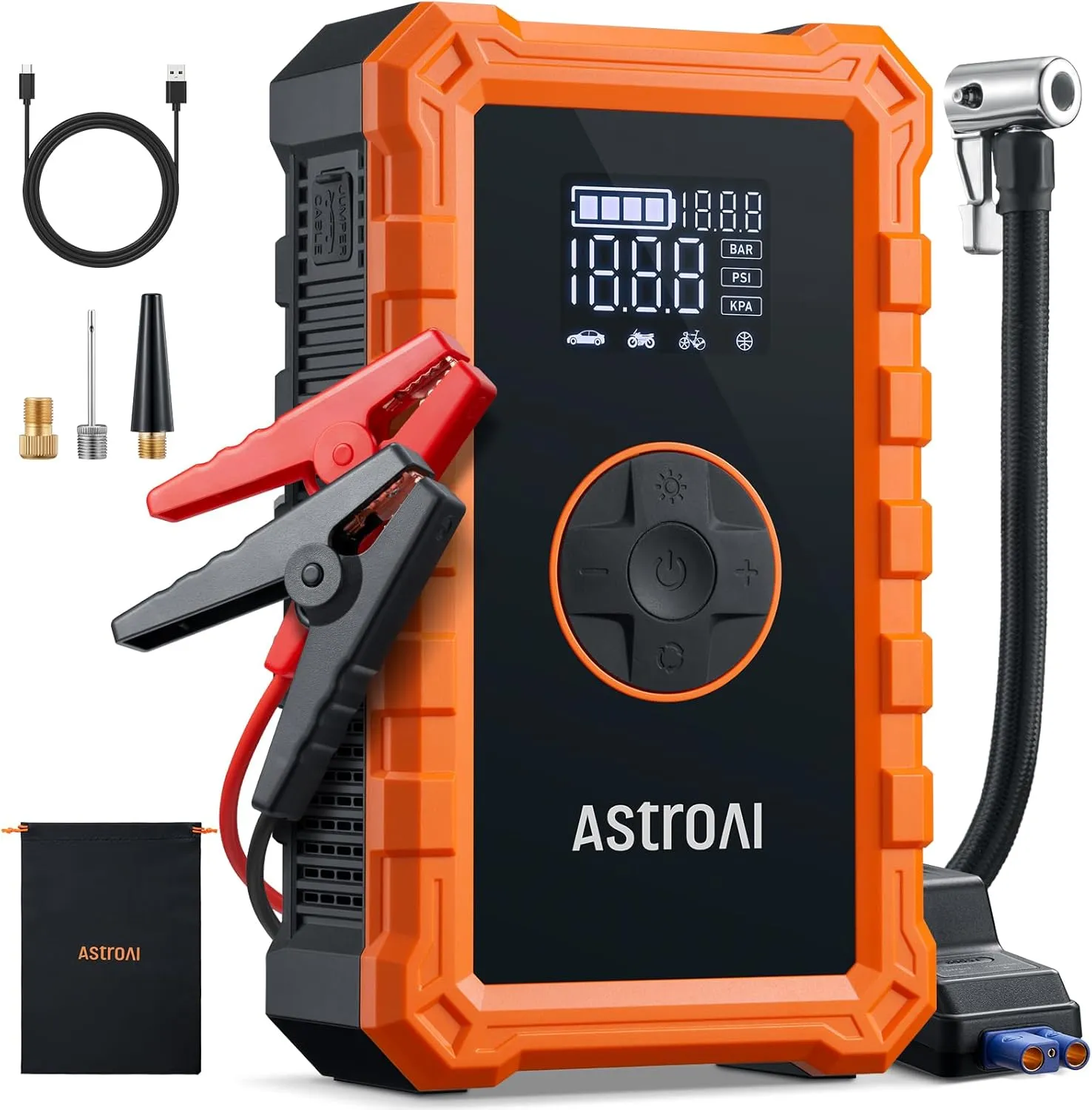
Balanced Daily and Travel Choice
Best for: commuters, family vehicles, and road-trip kits that need broadly useful jump-starting and faster routine tire top-offs in one case.
Why it fits: its 24.5 L/min published airflow is the highest listed among the four models here, making it a practical match for drivers who expect routine vehicle top-offs, not only rare emergencies.
Not best for: engines outside its published range or users who need a dedicated high-duty compressor.
View S8 Air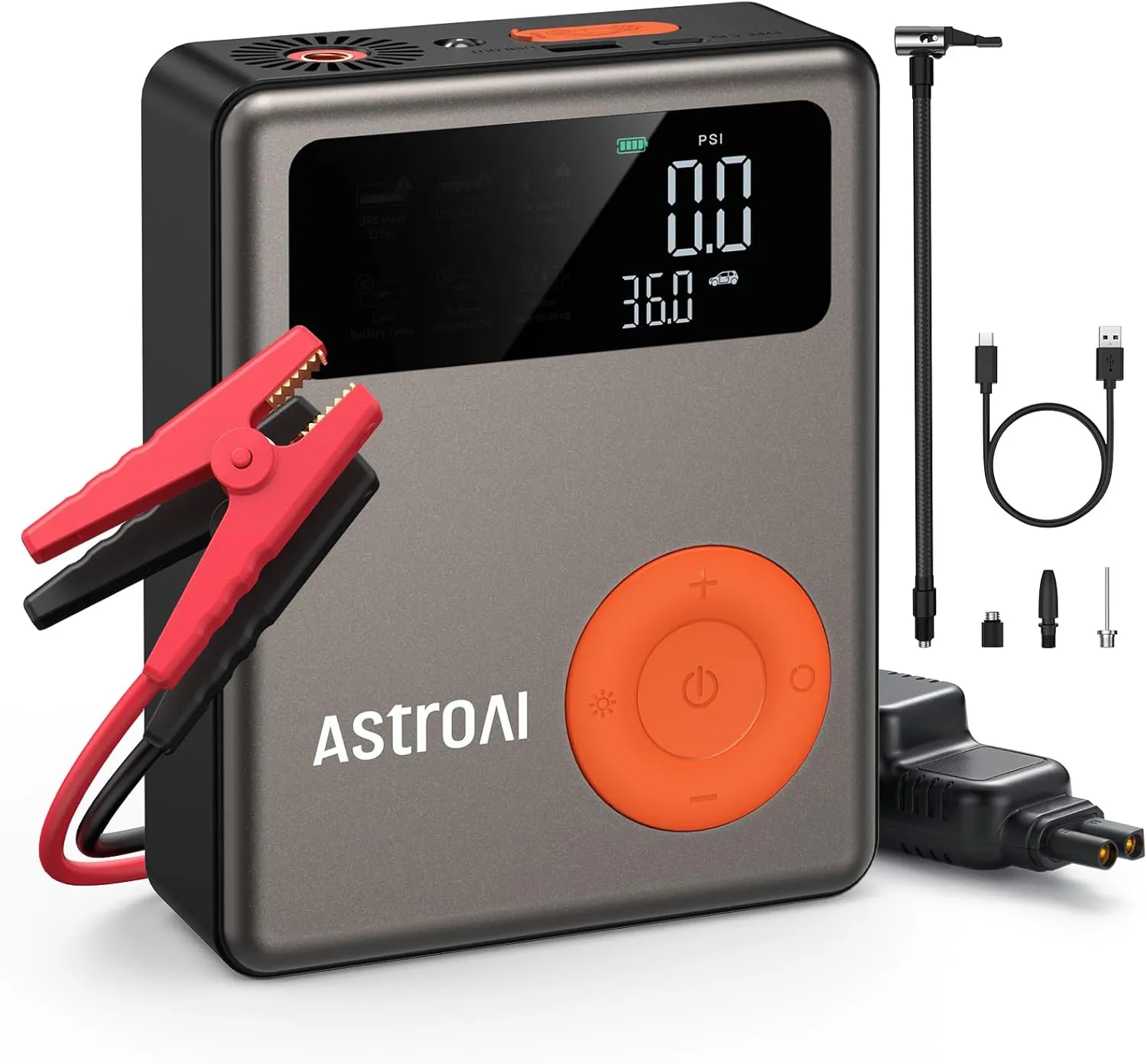
Compact Display-Led Option
Best for: second cars, mixed household vehicles, and users who value a large LCD and a compact integrated form.
Why it fits: its interface and compact packaging suit users who want one device for occasional battery recovery and measured tire-pressure correction.
Not best for: buyers prioritizing the highest airflow or the broadest published peak-current tier.
View MF139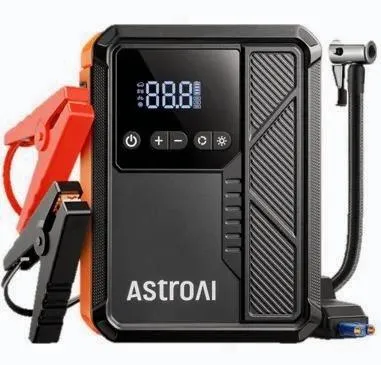
Larger-Engine Coverage
Best for: SUV, van, and pickup owners who want 3000A-class jump-starting with an auto-shutoff inflator.
Why it fits: it extends engine coverage while retaining preset inflation convenience for a vehicle-centered emergency kit.
Not best for: users who mainly inflate tires and would benefit more from the S8 Air's higher published airflow.
View Beta822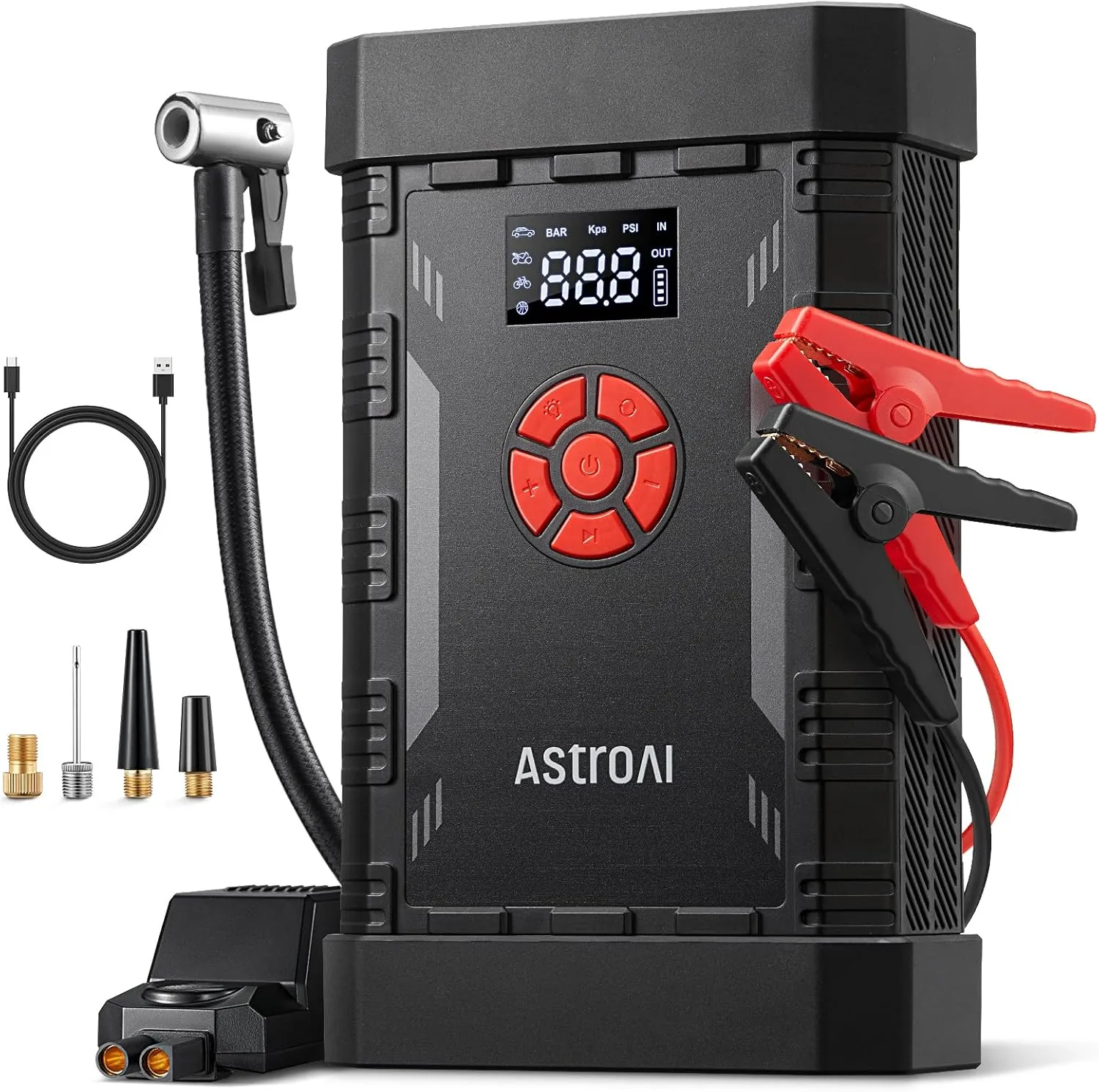
Highest Engine Tier Here
Best for: larger gasoline and diesel vehicles, colder starts, and travel where broader published engine coverage matters more than minimum size.
Why it fits: it gives drivers of larger vehicles a two-in-one option without asking them to treat maximum amperage as the only selection factor.
Not best for: compact-car owners who prioritize the smallest, lightest emergency kit.
View A30| Model | Peak Current | Published Engine Rating | Max Pressure | Lineup Airflow | Practical Match |
|---|---|---|---|---|---|
| S8 Air | 3000A | Up to 6L gas / 3L diesel | 150 PSI | 24.5 L/min | Daily driving and travel where inflation speed is a priority |
| MF139 | 1750A | Up to 7.5L gas / 5L diesel | 150 PSI | 14 L/min | Compact integrated tool with a large LCD |
| Beta822 | 3000A | Up to 9L gas / 7L diesel | 150 PSI | 15 L/min | SUV, van, and pickup coverage with auto shut-off |
| A30 | 4000A | Up to 10L gas / 8L diesel | 150 PSI | 20 L/min | Large gasoline and diesel vehicles needing broader engine coverage |
Specifications reflect AstroAI product details and the 2026 lineup comparison reviewed on August 12, 2026. Product configurations may change, so always verify the exact current configuration before purchase.
Use this sequence before choosing a model. It keeps convenience in perspective and prevents a high headline number from replacing vehicle compatibility.
Do not run the compressor while attempting to crank the engine unless the specific manual explicitly permits that sequence. Treat jump-starting and inflation as separate operations, monitor heat, and follow the model-specific duty cycle.
It is worth it for drivers who can realistically encounter both a weak battery and low tire pressure, want one portable emergency package, and will keep that package charged and inspected. For everyday commuting and travel, S8 Air offers the strongest published airflow of these four. MF139 emphasizes compact integrated control, Beta822 expands engine coverage with auto shut-off, and A30 reaches the broadest published gasoline and diesel engine range in this group.
Separate tools remain the better answer for frequent heavy inflation, the smallest possible jump pack, independent redundancy, or vehicles outside the selected combo tool's limits. Buy for the job you actually expect, not simply for the longest feature list.
You need both capabilities if your emergency plan should cover an undercharged 12V starting battery and low tire pressure. They solve different problems. Whether they should share one device depends on storage, vehicle size, inflation frequency, and how reliably you maintain rechargeable equipment.
It can be worth it for commuters, road-trip drivers, second-car households, and campers who value a compact all-in-one kit. It is less compelling when you already own one function, need frequent high-volume inflation, or want independent tools for redundancy.
A regular jump starter focuses on helping crank a compatible 12V vehicle and may be smaller. A combo unit adds an integrated compressor, pressure controls, hose, and inflation accessories, trading some size and specialization for broader roadside coverage.
A 150 PSI maximum is above the normal cold-pressure target of typical passenger-vehicle tires, but maximum PSI does not tell you how quickly or how long the unit can inflate. Use the vehicle placard target and compare airflow, tire volume, starting pressure, and duty cycle.
S8 Air is a strong daily-driving option when the vehicle fits its published 6L gasoline and 3L diesel range. Its listed 24.5 L/min airflow is the highest among S8 Air, MF139, Beta822, and A30, making it useful for routine top-offs as well as emergency storage.
Match engine displacement rather than vehicle label alone. Beta822 is published up to 9L gasoline and 7L diesel, while A30 is published up to 10L gasoline and 8L diesel. Verify that the exact vehicle uses a compatible 12V system and follow its approved jump-point instructions.
No. It only adds air. It cannot repair a puncture, sidewall cut, bulge, damaged valve, or unseated bead. Do not drive on a damaged or unsafe tire merely because it temporarily holds pressure.
Follow the exact model manual because storage temperature, age, and use affect charge retention. Check the level before long trips and periodically during storage; recharge after use rather than assuming the unit will remain ready indefinitely.