Tire Care Guide | August 14, 2026
How Long Can a Portable Tire Inflator Run Continuously?
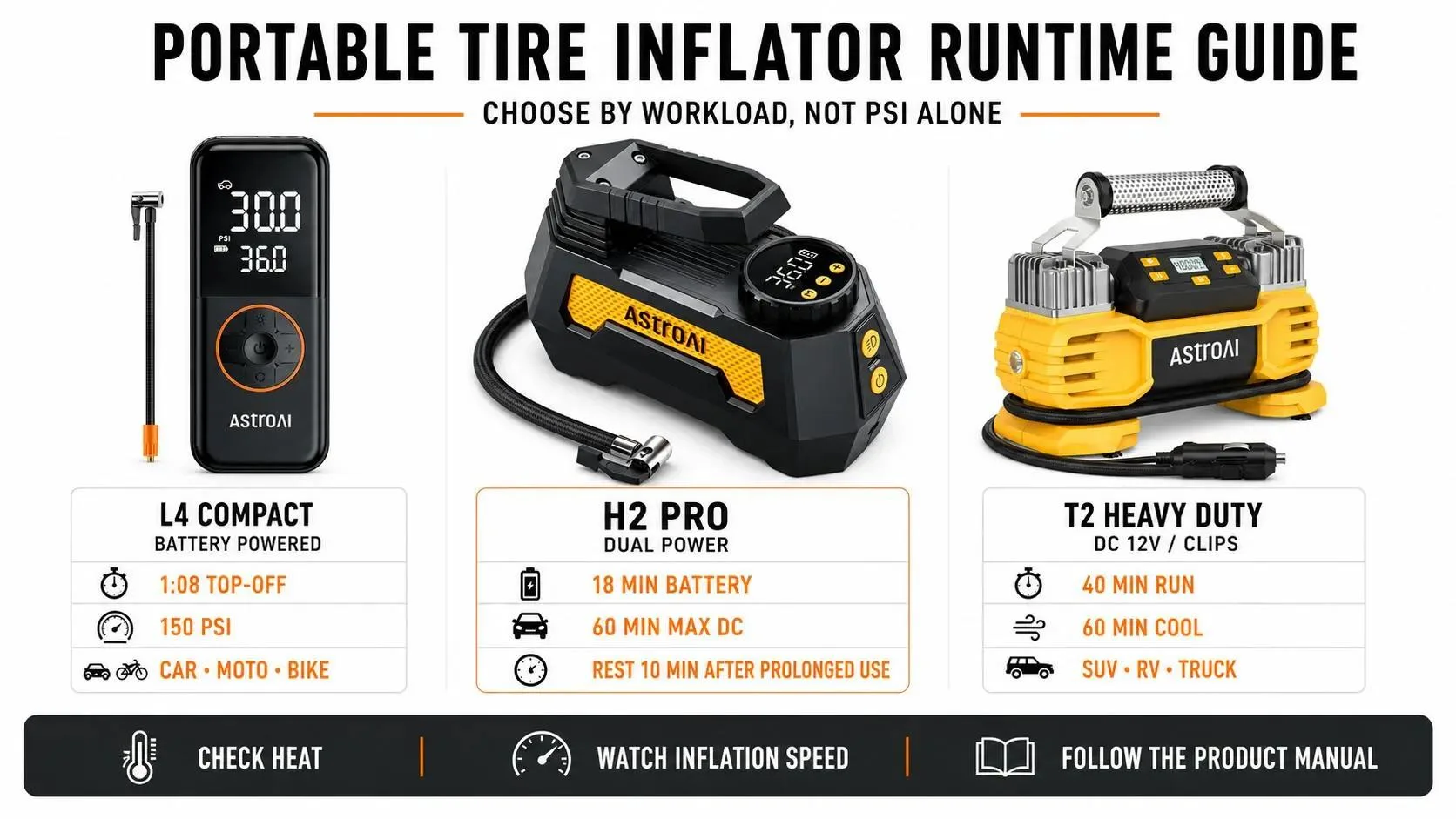
A portable tire inflator should run only as long as its own manual allows, and it may need to stop sooner when heat builds up. For the AstroAI H2 Pro, the current manual lists up to 18 minutes of battery operation and a 60-minute maximum working time in DC mode. It also instructs users to let the pump rest for at least 10 minutes after prolonged use. Those figures are limits, not targets. A normal passenger-car top-off may take about a minute, while a low SUV or truck tire can keep the compressor under load much longer.
Quick Answer
Routine car top-off: Adding a few PSI to one or four passenger-car tires is usually a short task. In the published AstroAI comparison, H2 Pro takes 60 seconds to raise a 195/65R15 tire from 30 to 36 PSI.
Very low tire: The same comparison lists 4 minutes 45 seconds for H2 Pro to inflate that test tire from 0 to 36 PSI. A larger SUV or truck tire contains more air, so its fill can take longer even when the target PSI is similar.
Cooling rule: Follow the product manual. H2 Pro should rest for at least 10 minutes after prolonged use, and reduced inflation speed is a reason to stop and cool it. DC power prevents battery depletion, but it does not eliminate motor and compressor heat.
The practical rule is simple: do not judge an inflator by maximum PSI alone. Compare inflation speed, tire volume, power source, cooling guidance, and continuous working capability. Stop early if airflow slows, the hose or housing becomes excessively hot, or thermal protection activates.
Three Runtime Numbers That Are Easy to Confuse
A claim such as "runs for 18 minutes" can describe battery endurance, while a duty-cycle instruction describes how long the pump mechanism should work before cooling. A maximum DC working time is another boundary. Read these separately.
Battery Runtime
How long the stored charge can power the inflator under specified conditions. Cold batteries, low charge, pressure load, and repeated starts can shorten real use.
Maximum Working Time
An upper operating boundary stated by the manufacturer. It does not mean every tire job should continue uninterrupted until that number is reached.
Cooling Interval
The rest period that lets the motor, cylinder, hose, seals, electronics, and battery return toward a normal operating temperature.
Why Portable Tire Inflators Get Hot
Heat is a normal result of compressing air and running a small electric motor under load. The risk increases when the inflator has to move more air, work against higher pressure, or operate in a hot environment.
- Air compression: Compressing air raises its temperature, and that heat transfers into the cylinder, hose, fittings, and surrounding housing.
- Motor and electrical loss: Current flowing through the motor and wiring produces heat. Higher load and lower supply voltage can increase stress.
- Large air volume: A taller or wider SUV or truck tire needs more air than a common sedan tire, even when both finish near the same pressure.
- High starting deficit: Raising a tire from 20 to 36 PSI is a much larger job than correcting it from 33 to 36 PSI.
- Ambient heat and restricted airflow: Direct sun, a hot road shoulder, or operating the pump inside a bag or enclosed cargo area slows heat removal.
- Loose valve or power connection: Air leakage or unstable voltage makes the pump run longer without completing the job efficiently.
Important: A hot housing is not an invitation to test its limit. H2 Pro's manual warns that the pump remains hot after use and should be handled by the switch and handle while hot. Do not charge an overheated unit; let it return to a normal ambient temperature first.
Real-Use Guide: Car Top-Off vs. SUV or Truck Inflation
The times below separate published same-tire benchmarks from practical estimates. Published times use a 195/65R15 test tire. Your result can change with tire size, starting pressure, ambient temperature, battery charge, supply voltage, valve seal, and required cool-down periods.
| Scenario |
Typical Workload |
H2 Pro Reference |
When to Pause |
| One sedan tire, routine top-off |
Usually a few PSI |
60 seconds for 30 to 36 PSI on 195/65R15 |
Normally no mid-job pause when the pump starts cool and operates normally. |
| Four sedan tires, routine top-offs |
Several short fills plus connection time |
About four minutes of pump time if every tire matches the 30 to 36 PSI benchmark |
Reassess temperature and inflation speed between tires. Stop if performance drops. |
| One sedan tire, near-flat recovery |
Large pressure increase |
4 minutes 45 seconds for 0 to 36 PSI on 195/65R15 |
Inspect for puncture or sidewall damage first. Stop if the tire will not hold pressure or the pump becomes abnormally hot. |
| SUV tire, significant pressure deficit |
More air volume than the published sedan-size test tire |
No universal time can be inferred from PSI alone |
Check the pump after each tire. Use the 10-minute cool-down when use becomes prolonged or inflation speed falls. |
| Truck, RV, or repeated large-tire work |
High air volume and longer total compressor-on time |
Consider a direct-power heavy-duty model instead of forcing a compact portable unit through the job |
Follow the selected model's own duty cycle. The T2 manual specifies a 60-minute cooling period after 40 minutes of use. |
Benchmark data uses a 195/65R15 tire. Do not intentionally reduce a mounted road tire to 0 PSI for a home comparison. A fully deflated tire can lose bead seating and may need professional inspection or equipment.
AstroAI H2 Pro: A Balanced Choice for Everyday and SUV Tire Care
Primary Recommendation
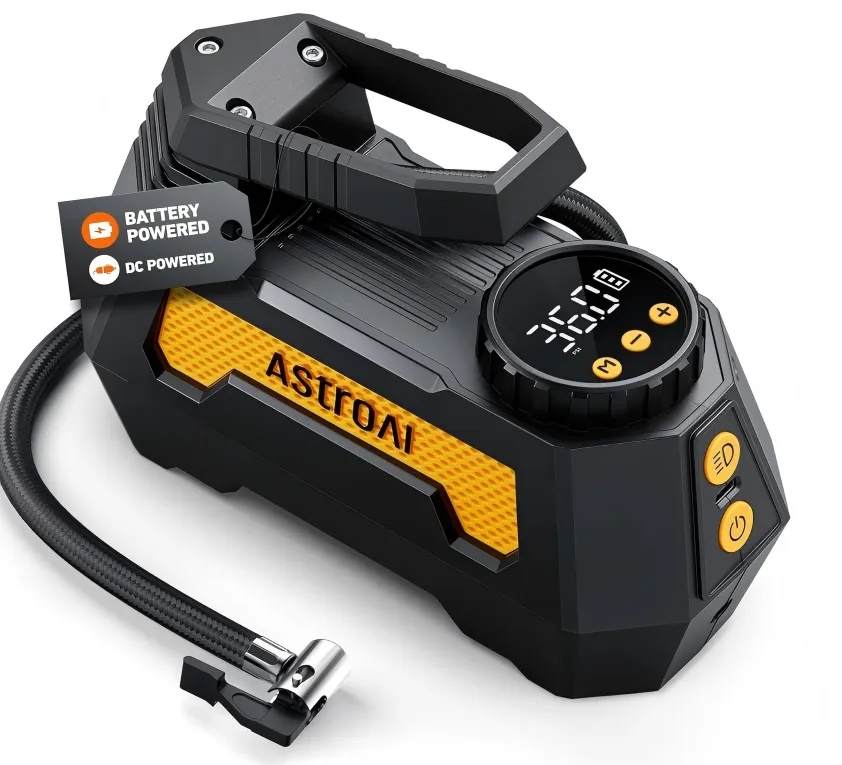
AstroAI H2 Pro Tire Inflator
Best for: Routine car top-offs, household SUV tire care, cordless use away from the vehicle, and DC-powered backup for longer tasks.
- 150 PSI maximum working pressure
- 23 L/min inflation speed and 120W rated power
- Battery and DC 12V power options
- 18-minute battery life; 60-minute maximum working time in DC mode
- High-temperature protection during battery discharge
Practical strength: Its dual-power design lets a driver use the battery for quick access and switch to DC 12V when the job needs more energy.
Pros: Flexible power, clear runtime guidance, compact storage, and published same-tire test data.
Cons: Battery operation is finite, and larger repeated tire jobs can still require cooling or DC power.
Not best for: Repeated truck or RV tire fills where a direct-power, dual-cylinder heavy-duty compressor is the more suitable class.
View H2 Pro
What the Runtime Figures Actually Mean
The current H2 Pro manual lists an 18-minute battery-life figure and a 60-minute maximum working time in DC mode. They describe two different power situations. Battery mode is convenient, but stored energy can run out. DC mode draws power from the vehicle outlet, but the motor and compressor still generate heat.
For a common 30 to 36 PSI top-off, the published 60-second benchmark is far below either runtime figure. The distinction becomes important when recovering a very low tire, inflating multiple large tires, or working in hot weather.
The manual also includes protective behavior: the motor can stop automatically when battery temperature becomes excessively high. If that happens, place the unit in a normal ambient-temperature location, allow it to cool, and restart manually only after temperature returns to normal.
Do not use the auto-protection system as your timer. It is a backup boundary. A driver should notice increasing heat, reduced speed, unusual sound, odor, or unstable operation and stop before repeated thermal shutdowns.
Choose by Workload, Not PSI Alone
Maximum PSI tells you the pressure range, not how quickly an inflator moves air or how long it can sustain a demanding job. These three AstroAI models represent different priorities.
Flexible Everyday Use
AstroAI H2 Pro
Dual power, 150 PSI, 60-second 30 to 36 PSI benchmark, and 4-minute 45-second 0 to 36 PSI benchmark.
Choose it for: Car and SUV top-offs when cordless convenience and DC backup both matter.
View H2 Pro
Large-Tire Workload
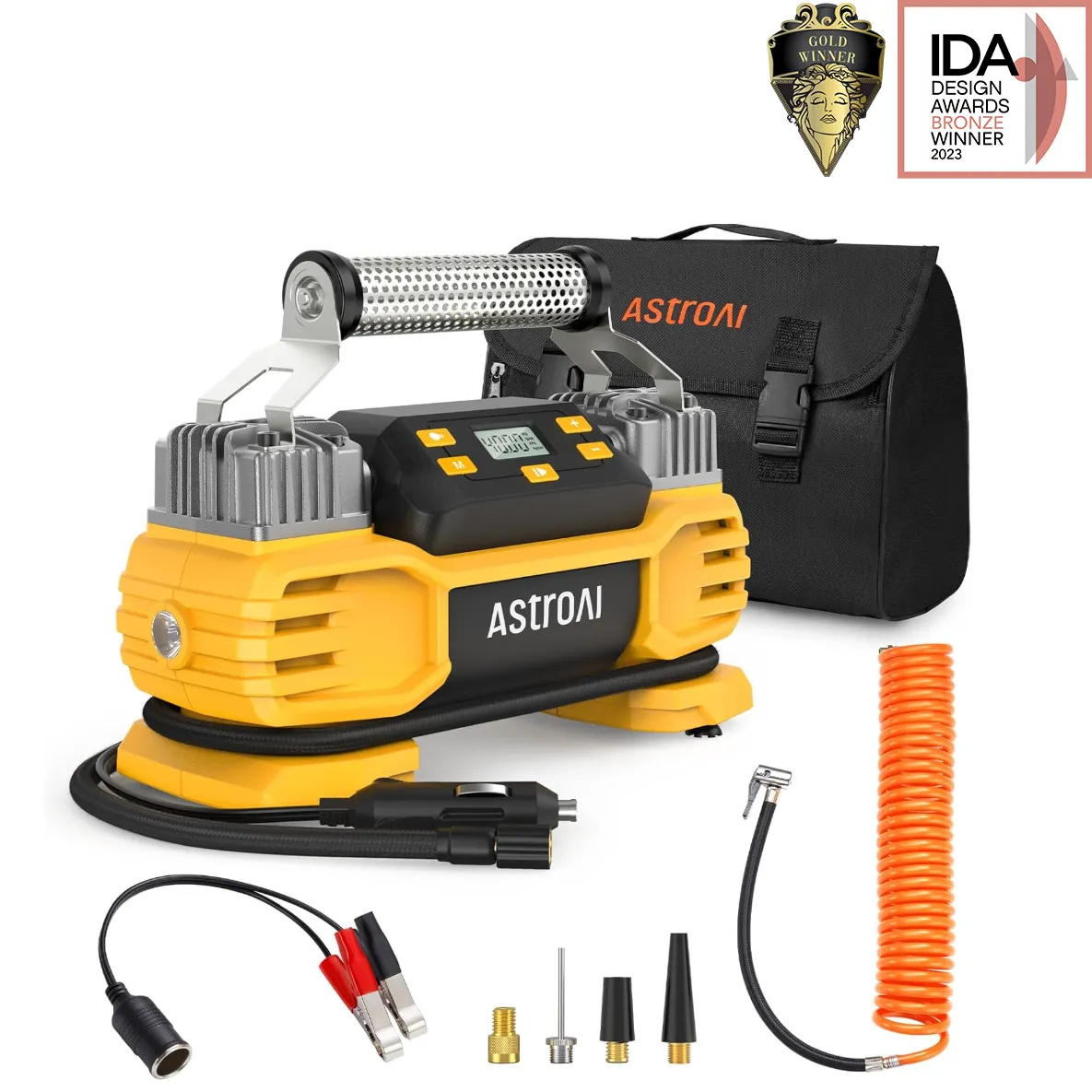
AstroAI T2 Heavy-Duty
Dual metal cylinders and motors, 160 PSI, DC power, 40-second 30 to 36 PSI benchmark, and 3-minute 50-second 0 to 36 PSI benchmark.
Choose it for: SUVs, RVs, trucks, and repeated larger-volume jobs. Its manual specifies 40 minutes of use followed by at least 60 minutes of cooling.
View T2
Compact Emergency Top-Offs
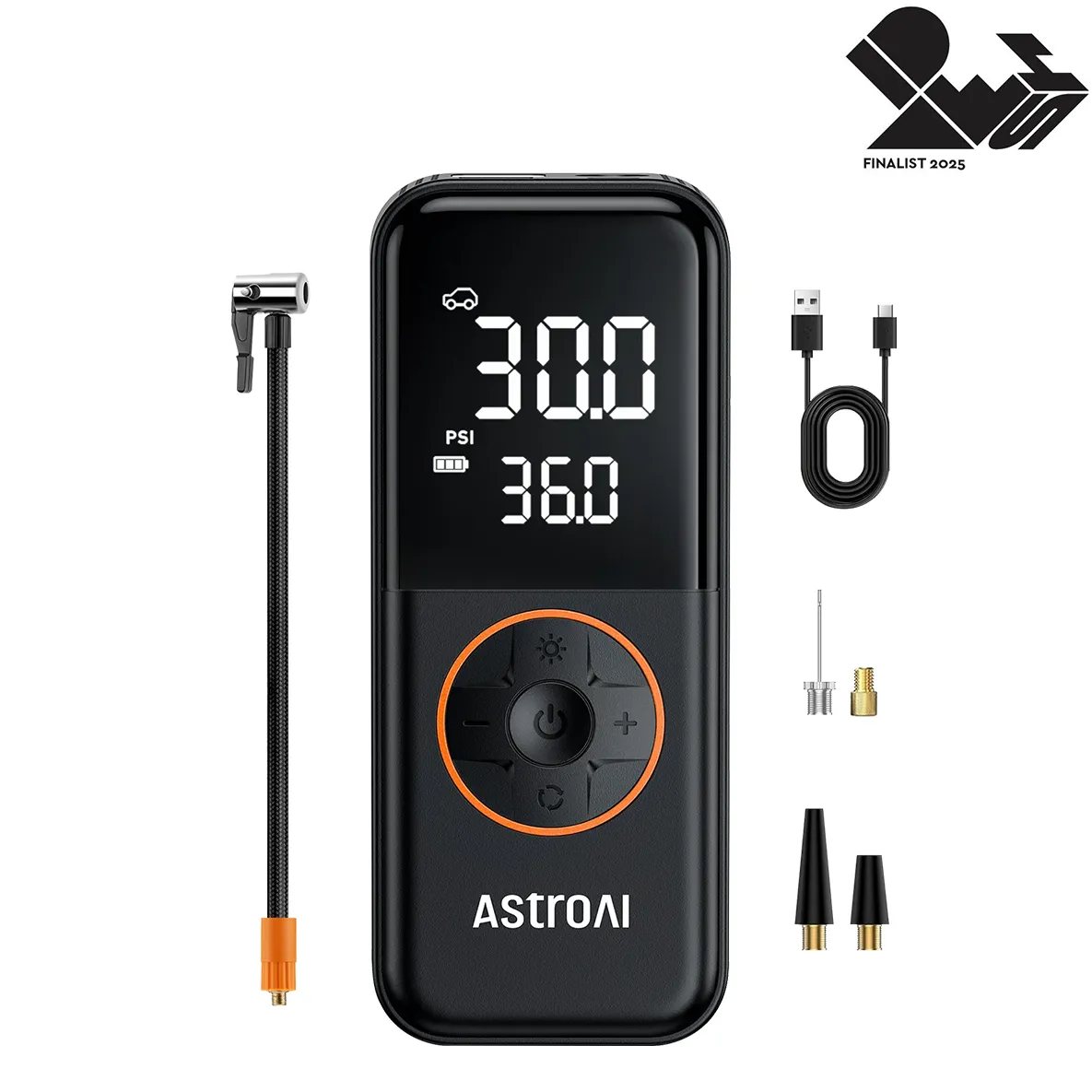
AstroAI L4
Battery power, 150 PSI, 1-minute 8-second 30 to 36 PSI benchmark, and 7-minute 6-second 0 to 36 PSI benchmark.
Choose it for: Compact cordless storage and occasional car, motorcycle, or bicycle top-offs rather than repeated large-tire recovery.
View L4
| Model |
Power |
Max Pressure |
30 to 36 PSI |
0 to 36 PSI |
Best Use |
| H2 Pro |
Battery / DC 12V |
150 PSI |
60 sec |
4 min 45 sec |
Flexible car and SUV care |
| T2 |
DC 12V / clips |
160 PSI |
40 sec |
3 min 50 sec |
SUV, RV, truck, repeated fills |
| L4 |
Battery |
150 PSI |
1 min 8 sec |
7 min 6 sec |
Compact occasional top-offs |
All inflation times in this comparison refer to the same published 195/65R15 test tire. Use them for relative selection, not as guaranteed times for every vehicle.
How to Decide Whether the Inflator Needs a Cooling Break
Use this process for ordinary tire care. It does not replace the selected model's manual.
-
1
Start with the tire and inflator cool. Read the vehicle placard for the recommended cold tire pressure, inspect the tire for visible damage, and place the inflator in open air away from hot exhaust components.
-
2
Make secure connections. Attach the hose firmly to the valve. For DC operation, use the required 12V connection and keep the vehicle power arrangement consistent with the product manual.
-
3
Set the target and note the start time. Use the placard pressure, not the maximum PSI printed on the tire or inflator. Timing helps you recognize a job that is taking unexpectedly long.
-
4
Reassess after each tire. Listen for a stable sound, check whether pressure is rising normally, and use the insulated handle rather than touching hot compressor or hose surfaces.
-
5
Stop at warning signs. Pause if inflation slows, the unit becomes excessively hot, operation sounds abnormal, a burning smell appears, pressure stops increasing, or thermal protection shuts the motor down.
-
6
Cool it in open air. Turn it off, disconnect it, and allow at least the manual's required rest period. For H2 Pro after prolonged use, that means at least 10 minutes. Do not cool it with water or charge it while overheated.
-
7
Restart and verify pressure. Resume only after the unit returns to normal temperature. When inflation is complete, let the pressure settle, recheck it, replace the valve cap, and investigate any tire that loses pressure again.
Common Mistakes That Increase Runtime and Heat
- Choosing by PSI only: Two 150 PSI inflators can have very different airflow, motor size, power source, cooling instructions, and large-tire suitability.
- Assuming DC means unlimited operation: DC power solves battery depletion, not compressor heat. Respect the DC working limit and cooling rule.
- Inflating a damaged tire: A puncture, leaking valve, sidewall damage, or unseated bead can make the pump run without solving the underlying problem.
- Using a hot or enclosed location: A pump cannot shed heat efficiently under luggage, inside a storage case, or beside a hot exhaust outlet.
- Ignoring voltage and battery charge: Weak battery power or an unstable 12V connection can reduce speed and extend the job.
- Running every tire to a sidewall number: Use the vehicle manufacturer's cold-pressure recommendation. The tire sidewall typically shows a maximum, not the everyday target.
Bottom Line
For an ordinary passenger-car top-off, a portable inflator often runs for only a minute or two per tire. A very low or larger tire can turn that into a much longer compressor-on period. H2 Pro is a practical dual-power choice because it combines cordless access with DC backup, but its 18-minute battery-life figure and 60-minute DC maximum are not interchangeable with a promise of heat-free continuous operation.
Start with the manual, watch temperature and speed, cool the pump before it struggles, and move to a heavy-duty model such as T2 when large tires or repeated fills make sustained airflow the main requirement.
Frequently Asked Questions
How long can a portable tire inflator run continuously?
There is no universal runtime. Follow the exact model's manual. Compact cordless models may be limited by battery energy and heat, while direct-power models can run longer but still need cooling. Stop earlier if inflation slows, the unit becomes excessively hot, or protection activates.
How long can the AstroAI H2 Pro run?
The current H2 Pro manual lists 18 minutes of battery life and a 60-minute maximum working time in DC mode. It also says to rest the pump for at least 10 minutes after prolonged use. Treat those as operating boundaries and stop sooner if heat or reduced speed appears.
Can I inflate all four car tires without stopping?
Four small top-offs may require only a few minutes of total pump time. Four near-flat tires are a much larger task. Check temperature and performance between tires, follow the manual, and add a cooling break whenever use becomes prolonged or inflation speed drops.
How do I know when a tire inflator is overheating?
Warning signs include reduced airflow, unusually slow pressure rise, excessive surface or hose heat, unstable sound, odor, automatic shutdown, or a temperature-related protection state. Turn the pump off and cool it in open air before trying again.
Why does an SUV tire take longer than a car tire?
Many SUV tires have greater internal air volume than a common passenger-car tire. Moving that additional air takes more time and produces more heat, even when the final pressure is similar.
Does a higher maximum PSI mean faster inflation?
No. Maximum PSI describes pressure capability. Inflation speed depends on airflow, motor and cylinder design, power supply, tire volume, starting pressure, valve seal, and operating temperature.
Can a DC-powered tire inflator run indefinitely?
No. DC power can provide energy without depleting a built-in battery, but the compressor and motor still generate heat. Follow the maximum working time and cooling interval stated for the selected model.
What should I do if a very low tire takes unusually long to inflate?
Stop and inspect the hose connection, valve, tread, and sidewall. A puncture, leak, damaged tire, or unseated bead can prevent pressure from rising normally. Do not keep running the inflator to compensate for a tire that needs repair or professional inspection.
Technical References
Actual time varies with tire size, starting pressure, temperature, power condition, connection quality, and required cool-down periods.
Match the Inflator to the Workload
Choose H2 Pro for flexible everyday car and SUV care, T2 for sustained larger-tire work, or L4 when compact cordless storage matters most.