Everyday Tire Care Guide | August 20, 2026
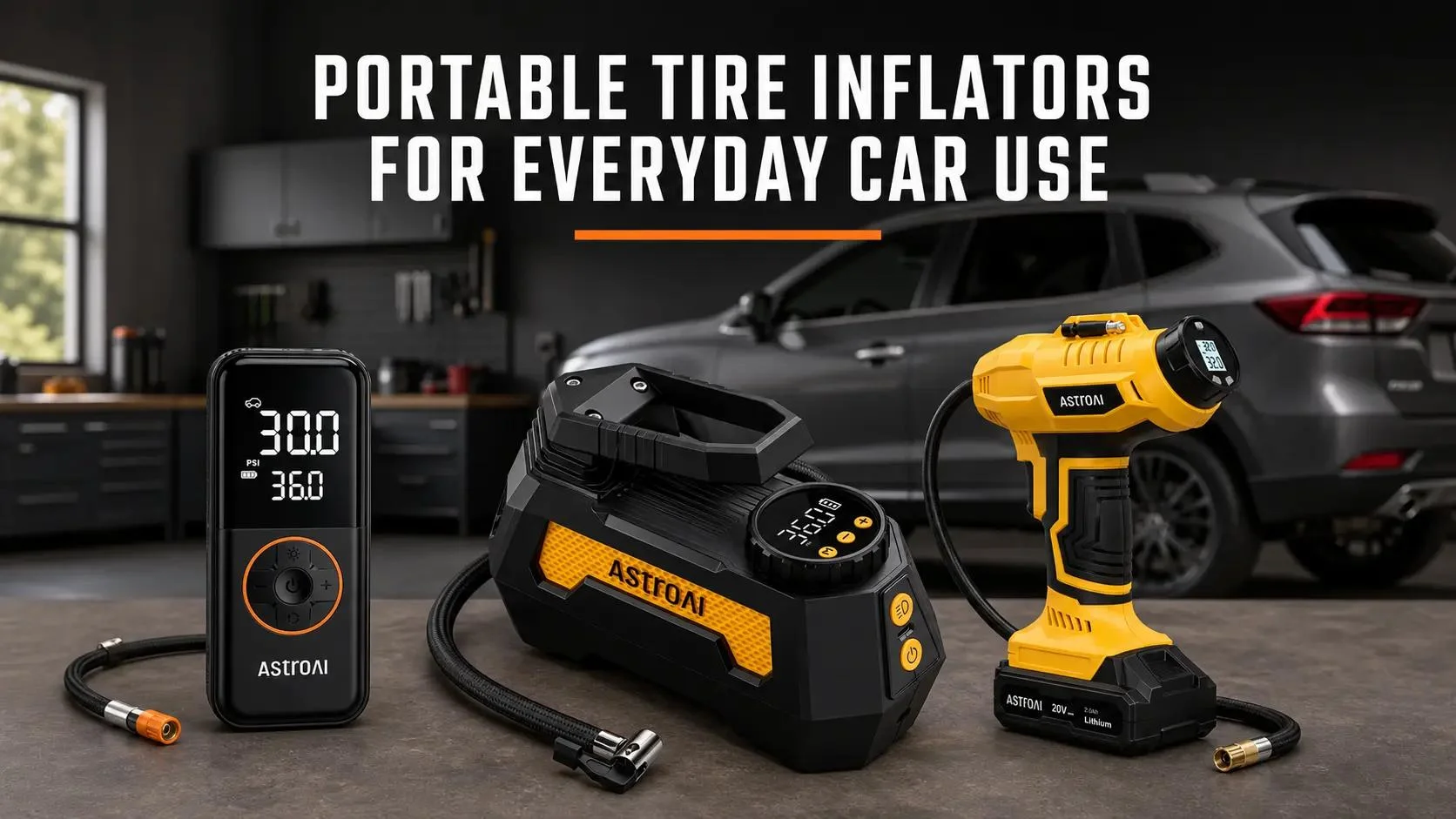
A Practical Portable Tire Inflator for Everyday Car Use
For everyday drivers, a practical portable tire inflator should complete routine passenger-car top-offs efficiently, reach all four tires without awkward repositioning, and still offer a dependable power option when its battery is low. The AstroAI H2 Pro is a strong all-around recommendation for daily vehicle carry because its dual battery and 12V DC power, 23 L/min rated airflow, useful reach, and integrated accessory storage suit both everyday cars and mixed car-and-SUV households. Choose C2 when a handheld cordless form is the priority, or L4 when compact emergency storage matters most.
Quick Answer
Everyday-carry recommendation - AstroAI H2 Pro: A dual-power model for routine car care and mixed car-and-SUV households, with 23 L/min rated airflow, a 1.8 ft hose, a 9.8 ft DC cord, and integrated accessory storage.
Handheld alternative - AstroAI C2: A handheld dual-power model for commuters, family cars, and emergency backup. The published comparison lists 50 seconds for a 30-36 PSI top-off on a 195/65R15 tire in battery mode.
Compact emergency-kit alternative - AstroAI L4: A flat cordless form with a 0.98 ft hose, car inflation mode, illumination, and power-bank output. It favors portability over rapid near-flat recovery.
A 150 or 160 PSI label does not tell you how quickly a pump moves air, how long it can operate, or whether its hose and power cable can reach the valve comfortably. For passenger-car use, compare the same tire and pressure window, then add power reliability, reach, heat management, and storage to the decision.
Recommendations by Everyday Use
Three Portable Tire Inflators for Different Car Owners
H2 Pro is the all-around recommendation for everyday vehicle carry, while C2 and L4 remain useful alternatives for different storage and handling priorities. The right fit depends on where the vehicle is parked, how many vehicles share the pump, and whether handheld convenience or minimum storage size matters most.
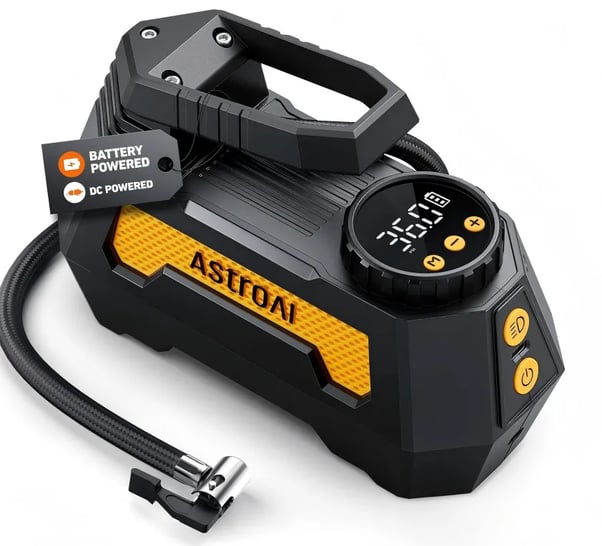
Practical everyday-carry recommendation
AstroAI H2 Pro Tire Inflator
Verified summary: A 150 PSI inflator with 23 L/min rated airflow, lithium-battery and DC 12V power, pressure preset, automatic shut-off, LED display, and accessory storage.
Best fit: Everyday vehicle carry for households that maintain passenger cars and SUVs, especially when a long vehicle-power reach and organized adapters are useful.
Pros: The manual lists a 1.8 ft hose and 9.8 ft DC power cord. The published comparison records 60 seconds from 30 to 36 PSI and 4 minutes 45 seconds from 0 to 36 PSI on a 195/65R15 tire.
Cons / Not best for: It is larger than L4 and still requires cooling after prolonged use. It is not the preferred category for repeated large truck or RV tire fills.
View H2 Pro
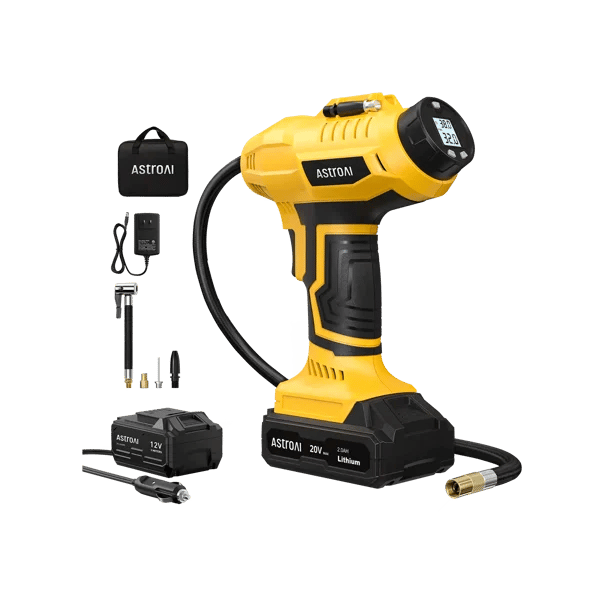
Handheld alternative for commuters
AstroAI C2 Handheld Cordless Tire Inflator
Verified summary: A 160 PSI handheld inflator powered by a rechargeable 20V battery or a vehicle's 12V DC socket, with pressure preset, real-time display, and automatic shut-off.
Best fit: Drivers prioritizing handheld cordless access for family cars, driveway maintenance, and emergency backup without relying on battery charge alone.
Pros: The current product information lists a 19.7 in hose and 9.84 ft DC cable. In the published 195/65R15 test, battery mode takes 50 seconds from 30 to 36 PSI.
Cons / Not best for: The handheld battery-and-charger kit takes more storage space than a flat pocket-style pump. It is not intended to automatically deflate an overinflated tire to a preset pressure.
View C2
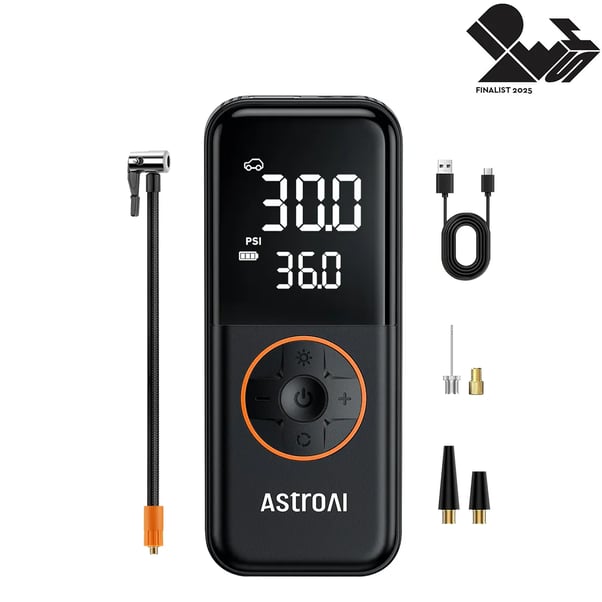
Compact emergency-kit option
AstroAI L4 Portable Tire Inflator
Verified summary: A 150 PSI rechargeable inflator with car, motorcycle, bicycle, ball, and custom modes, a 0.98 ft hose, illumination, SOS light mode, and USB power-bank output.
Best fit: Compact emergency kits, apartment parking, and drivers combining compact-car, motorcycle, or bicycle use where storage volume is tightly limited.
Pros: Cordless placement avoids routing a cable through the vehicle. The published comparison records 1 minute 8 seconds from 30 to 36 PSI on a 195/65R15 tire.
Cons / Not best for: The same comparison lists 7 minutes 6 seconds from 0 to 36 PSI. It is less suitable for drivers who frequently recover very low tires or need a vehicle-power fallback.
View L4
How to Choose a Portable Tire Inflator for Everyday Car Tires
1. Start With Tire Volume
A common passenger-car tire needs less air than an SUV, pickup, trailer, or RV tire. Maximum PSI alone does not describe how much air the pump moves.
2. Match the Power Source
Cordless power is easier around parked cars. A DC 12V backup is valuable when the rechargeable battery is low or several tires need attention.
3. Compare Top-Off Speed
For routine car care, a 30-36 PSI result is more representative than a 0-36 PSI recovery. Always compare the same tire size and power mode.
4. Measure Total Reach
For corded use, consider the route from the 12V socket to the pump plus the hose to the valve. A long cable is less useful if it snags or cannot be stored neatly.
5. Plan the Storage Location
Decide whether the pump belongs in a glove box, side pocket, trunk organizer, garage shelf, or shared family emergency kit before choosing its shape.
6. Check Heat and Duty Limits
Compact pumps generate heat. Follow the exact manual's operating and cool-down instructions, especially across several tires or a large pressure increase.
Which Inflator Fits Your Actual Driving Routine?
| Driver Scenario |
What Matters Most |
Suggested Fit |
Reason |
| Daily commuter |
Fast routine top-offs and simple setup |
C2 |
Cordless handling for the normal job, plus a 12V backup if charging was forgotten. |
| Two-car family |
Flexible power and organized accessories |
C2 or H2 Pro |
Both offer cordless and DC operation. H2 Pro's integrated accessory storage is useful when the kit moves between vehicles. |
| Car and crossover or SUV |
Broader tire-volume coverage |
H2 Pro |
Published compatibility includes cars and SUVs, while dual power reduces dependence on one battery charge. |
| Small trunk or emergency bag |
Compact shape and cordless placement |
L4 |
Its cordless flat format and USB output prioritize packability, though near-flat recovery is slower. |
| Frequent large truck or RV work |
Higher air volume and sustained operation |
Choose a heavy-duty category |
Do not force a compact car inflator through a workload better suited to a clamp-powered T-series compressor. |
How the Published Inflation Times Should Be Read
The AstroAI comparison uses a 195/65R15 tire and reports both 30-36 PSI and 0-36 PSI times. The first is closest to an everyday correction. The second places a much larger demand on the compressor and is useful only as a comparative load reference.
Do not intentionally reduce a mounted road tire to 0 PSI for a home speed test.
A fully deflated tire can lose bead seating and may require professional equipment. Compare routine top-offs on the same cold tire instead.
| Model |
Max Pressure |
Power |
30-36 PSI |
0-36 PSI |
Reach and Storage |
| C2 |
160 PSI |
20V battery / DC 12V |
50 sec battery
1 min 20 sec DC |
4 min 30 sec battery
7 min 30 sec DC |
19.7 in hose; 9.84 ft DC cable; handheld kit |
| H2 Pro |
150 PSI |
Lithium battery / DC 12V |
60 sec |
4 min 45 sec |
1.8 ft hose; 9.8 ft DC cord; integrated accessory storage |
| L4 |
150 PSI |
Rechargeable battery |
1 min 8 sec |
7 min 6 sec |
0.98 ft hose; compact cordless form; USB output |
Published times are comparative references, not guarantees. Tire size, starting pressure, ambient temperature, battery charge, DC supply voltage, valve seal, and required cooling can change real results.
Cord Reach and Storage Matter More Than They Look
For cordless use, hose length controls placement. A compact pump can sit near the wheel without routing a cable through doors or around the vehicle. This is helpful in narrow parking spaces, shared garages, and curbside parking.
For 12V operation, calculate the full route. The power cord must travel from the vehicle socket to a stable pump position, and the hose must then reach the valve without pulling sideways. C2 lists a 9.84 ft DC cable and H2 Pro lists a 9.8 ft DC cord, but socket location and vehicle length still determine real reach.
Storage should preserve readiness. Keep the inflator, hose, charging cable, 12V cable, adapters, and manual together. Do not store the unit with a sharply kinked hose, a crushed connector, or a depleted battery for long periods.
Emergency-kit boundary: A tire inflator can restore pressure after a small pressure loss, but it cannot repair a puncture, damaged valve, sidewall bulge, exposed cord, or a tire that will not hold air. Carry a pressure gauge and the vehicle's required roadside equipment as separate tools.
How to Use a Portable Tire Inflator for a Routine Car Top-Off
This sequence is for an intact road tire that needs a normal pressure correction. Follow the instructions for the exact inflator and vehicle.
-
1
Check the tire while cold.
Park on a stable surface and use the vehicle's recommended cold tire pressure from its tire-information label or owner's manual, not the maximum pressure printed on the tire sidewall.
-
2
Inspect the tire and valve.
Do not inflate a tire with visible sidewall damage, exposed cord, a severe bulge, an unseated bead, or another condition that requires professional inspection.
-
3
Select and prepare the power source.
Use a charged battery for cordless operation or connect the required 12V cable exactly as the product manual specifies. Keep cables clear of hot, sharp, and moving vehicle parts.
-
4
Connect the hose securely.
Remove the valve cap and attach the connector squarely to the valve stem. A loose seal wastes airflow and makes the pump run longer.
-
5
Set the target pressure.
Choose the correct pressure unit and enter the vehicle-recommended pressure. Recheck the target before starting the motor.
-
6
Inflate while monitoring the pump.
Start inflation and watch pressure rise. Stop if the tire does not gain pressure, air leaks at the connection, the sound changes abnormally, or the unit becomes excessively hot.
-
7
Verify the final pressure.
After automatic shut-off, let the reading settle and confirm the pressure. Remove the connector promptly and replace the valve cap.
-
8
Cool, recharge, and store the kit.
Follow the required cool-down period, recharge battery models before returning them to the vehicle, and store cables and adapters without sharp bends.
Common Buying and Use Mistakes
- Choosing by maximum PSI alone: Car tires rarely need anything close to a 150 PSI ceiling; inflation speed and tire volume are more useful.
- Comparing different pressure windows: A 30-36 PSI top-off and a 0-36 PSI fill are not equivalent tests.
- Ignoring the DC socket location: Measure the actual route to the rear wheel before assuming a listed cord length is enough.
- Storing a cordless unit uncharged: Check and recharge the battery periodically so the emergency tool is ready.
- Running through overheating symptoms: Reduced speed, excessive heat, or automatic shutdown means it is time to stop and follow the cool-down instructions.
- Treating an inflator as a repair: Repeated pressure loss needs inspection; adding air does not fix the cause.
Final Recommendation
Choose C2 for the broadest everyday commuter and family-car fit, especially when cordless convenience and 12V backup should live in the same kit.
Choose H2 Pro when a household maintains both passenger cars and SUVs and values longer reach plus organized accessory storage.
Choose L4 when compact cordless storage is the priority and most jobs are occasional top-offs rather than repeated recovery from very low pressure.
Frequently Asked Questions
Which portable tire inflator is a practical choice for everyday car use?
For commuters and family vehicles, AstroAI H2 Pro is a practical all-around recommendation because its dual battery and 12V DC power, useful reach, automatic shut-off, and organized accessory storage cover routine car care while extending naturally to mixed car-and-SUV households. C2 is the handheld alternative for drivers who prioritize cordless handling.
Is a cordless tire inflator better than a 12V model?
Cordless operation is easier around the vehicle, but a 12V model does not depend on stored battery charge. A dual-power inflator combines both advantages, while a compact battery-only model is better when storage space matters most.
How fast should a portable tire inflator fill a car tire?
Judge speed using the same tire and pressure window. In the published 195/65R15 comparison, C2 takes 50 seconds in battery mode, H2 Pro takes 60 seconds, and L4 takes 1 minute 8 seconds to move from 30 to 36 PSI.
Do I need a 150 or 160 PSI inflator for normal car tires?
That ceiling provides operating range, but it does not mean a normal car tire should be inflated to 150 or 160 PSI. Always use the vehicle's recommended cold tire pressure and compare airflow, speed, power, reach, and duty limits.
How long should the power cord be for a car tire inflator?
It must reach from the vehicle's 12V socket to a stable pump position near every tire, with the hose completing the route to the valve. C2 lists a 9.84 ft DC cable and H2 Pro lists a 9.8 ft DC cord, but vehicle and socket layouts differ.
Can I keep a cordless tire inflator in the car?
Yes, when storage conditions follow the product manual. Avoid prolonged extreme heat, moisture, crushed hoses, and a deeply discharged battery, and check the kit periodically.
Can a portable inflator repair a slow leak?
No. It can restore pressure temporarily, but it cannot repair a puncture, damaged valve, wheel leak, or sidewall problem. A tire that repeatedly loses pressure needs inspection and repair.
Is L4 enough for a passenger car?
L4 is suitable for passenger-car top-offs and compact emergency storage. Choose a dual-power model instead when you expect frequent near-flat recovery, several vehicles, or a need for 12V backup.
Product specifications and comparative times were checked against current AstroAI product information, manuals, and the 2026 performance comparison on August 20, 2026. Follow the instructions for the exact product and vehicle.